
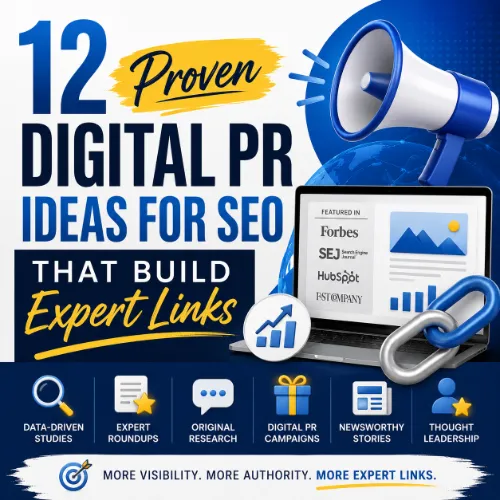
digital PR ideas for SEO Key Takeaways
These digital PR ideas for SEO help marketers earn high-authority backlinks and improve search rankings through strategic media outreach and content campaigns.
- digital PR ideas for SEO combine traditional public relations tactics with link-building goals to secure placements on news, industry, and lifestyle sites.
- Campaigns that use data, expert commentary, or creative assets tend to earn more links and social shares.
- Consistent digital PR activity supports long-term domain authority growth and protects against algorithm volatility.
Why digital PR ideas for SEO Matter in 2025
Search engines increasingly reward brands that earn mentions from authoritative sources. Traditional link building — guest posts and directory submissions — still works, but editorial links from news outlets, industry publications, and respected blogs carry more weight. Digital PR for SEO bridges the gap between brand visibility and link acquisition by focusing on stories, data, and expert insights that journalists actually want to cover.
When you earn a backlink from a site like Forbes, The Guardian, or a niche trade publication, you signal trust. That signal translates into higher rankings for your target keywords. The 12 strategies below cover different angles — from data journalism to reactive media commentary — so you can pick the approach that fits your team’s strengths. For a related guide, see Authority Site Strategies: 7 Proven Ways to Build Authority Sites Like SANTOLLUCKY.
12 Actionable digital PR ideas for SEO
1. Create Original Industry Data
Journalists love exclusive data. Conduct a survey, analyze public datasets, or run an experiment that reveals a surprising trend. Write a press release or pitch email highlighting the most newsworthy finding. Include a link to a dedicated landing page where reporters can download the full report. This tactic regularly earns links from multiple outlets covering the same story.
Actionable tip: Use tools like SurveyMonkey or Google Forms to collect responses from at least 500 people. Focus on a question that challenges a common assumption in your niche.
2. Offer Expert Commentary for “Help a Reporter” Queries
Platforms like Help a Reporter Out (HARO), Connectively, and Qwoted connect journalists with sources. Sign up, select your industry categories, and respond to relevant queries within a few hours. When your quote gets published, you earn a backlink from a news site or blog. This is one of the most consistent SEO PR strategies for beginners.
Actionable tip: Set up email alerts for keywords related to your expertise. Respond only to queries where you can genuinely add value — quality over quantity wins here.
3. Build a Interactive Tool or Calculator
Interactive assets like ROI calculators, savings estimators, or assessment quizzes attract links naturally. Publishers embed them as a resource for their readers, and each embed includes a backlink. This approach works especially well for finance, health, and B2B SaaS topics.
Actionable tip: Start simple — an embeddable HTML/JavaScript widget that solves a common question in your industry. Promote it on product hunt and relevant subreddits.
4. Write a “State of the Industry” Report
Annual reports that compile trends, benchmarks, and expert predictions become reference material for journalists. Format the report as a PDF or a dedicated microsite. Promote it to trade publications and niche bloggers in the weeks after launch.
Actionable tip: Include at least one visual — an infographic or chart — that tells the main story at a glance. Make it easy to embed with a copy-paste code snippet.
5. React to Breaking News with a Timely Quote
When a major story breaks in your industry, publish a reaction piece on your blog and pitch it to journalists covering the event. Use a tool like Google Alerts or Meltwater to monitor breaking stories relevant to your niche. Speed matters — send your pitch within the first 24 hours.
Actionable tip: Keep a pre-drafted template for reaction quotes. Customize the first paragraph for each news event, then add your specific angle.
6. Conduct a Localized Study or Map
Local data performs well with regional news outlets. Create a study that compares prices, salaries, weather, or other metrics across cities or states. Visualize the results on a map. Local newspapers and city blogs often pick up this kind of story.
Actionable tip: Use Google Public Data Explorer or Census Bureau data to build the map. Offer exclusive access to one local outlet in each region you cover.
7. Partner with Influencers for Co-Branded Research
Collaborating with an influencer or another brand doubles your reach. Joint surveys, webinars, or whitepapers generate buzz across both audiences. Each partner promotes the asset, which often leads to multiple backlinks from different domains.
Actionable tip: Choose a partner whose audience overlaps but does not directly compete with yours. Agree on a shared landing page or microsite before launching.
8. Create a Viral Challenge or Movement
Social movements like the #IceBucketChallenge show how participation can generate massive press coverage. Create a challenge that relates to your industry — for example, a “Zero Waste Week” for sustainability brands. Secure initial participants, then pitch the story to lifestyle and news outlets.
Actionable tip: Keep the challenge simple and shareable. Use a unique hashtag and track mentions to identify journalists who already cover similar topics.
9. Publish a Data-Backed Infographic
Infographics remain one of the most linked-to content formats. Find a dataset with a clear, surprising insight, then design a clean infographic. Host it on your site with an embed code. Reach out to bloggers and journalists who have previously covered the topic.
Actionable tip: Use Canva or Piktochart for design. Include 5 to 7 key statistics, each supported by a source citation.
10. Host a Virtual Event or Webinar with Notable Speakers
Virtual events attract speaker audiences and media attention. Record the session, publish a recap with quotes, and pitch the recap to industry publications. Each speaker likely has a personal blog or company site that will link to your event page.
Actionable tip: Choose a topical theme that aligns with a current news cycle. Promote speaker announcements individually to maximize coverage.
11. Run a Contest or Giveaway for a Social Cause
Contests that benefit a charity or community cause get picked up by local news and lifestyle blogs. Partner with a nonprofit, donate a portion of proceeds, or offer a prize that aligns with your brand values. Announce winners publicly and include links to your site.
Actionable tip: Make the contest easy to enter — one step, no email required. Use a tool like Gleam or Rafflecopter to manage entries.
12. Curate a Expert Roundup Post
Interview 10 to 20 experts in your niche on a single topic. Publish their answers as a roundup post. Each participant will likely share the article and link to it from their own site. Roundups also attract links from other bloggers who reference the collective wisdom.
Actionable tip: Email experts individually with a clear question and deadline. Offer to include a brief bio and link to their site in exchange for their answer.
SEO Entities and Their Functions
When executing digital PR ideas for SEO, understanding a few key entities helps you measure and prioritize efforts:
- Referring domains — the number of unique websites linking to you. This metric directly correlates with domain authority.
- Organic traffic — estimates the number of visitors from search engines. Track this before and after a PR campaign to see real impact.
- Keyword difficulty (KD) — a score that shows how hard it is to rank for a specific term. Digital PR campaigns often target low-KD terms first to build momentum.
- Domain Rating (DR) — a proprietary metric from Ahrefs that measures the strength of a site’s backlink profile. Use it to evaluate link prospects.
- Broken backlinks — links pointing to pages that no longer exist. Use a tool like Ahrefs to find broken links on relevant pages, then suggest your resource as a replacement.
- Unlinked mentions — instances where your brand is mentioned but not linked. Reach out to the site owner and politely ask for a link.
Useful Resources
- Ahrefs: Digital PR Guide for SEOs — In-depth walkthrough of how to plan and execute digital PR campaigns that earn links.
- Moz: Digital PR Best Practices — Practical advice on pitching journalists and measuring PR impact on SEO performance.
Digital PR ideas for SEO combine creativity and strategy to earn high-quality backlinks that drive lasting search visibility. Start with one or two tactics, track your results, and scale what works. Over time, consistent digital PR becomes a competitive advantage that algorithms and audiences both reward.
Frequently Asked Questions About digital PR ideas for SEO
What is digital PR for SEO ?
Digital PR for SEO is the practice of using public relations tactics — such as media outreach, data journalism, and influencer partnerships — to earn backlinks and improve a website’s search engine rankings. For a related guide, see 9 Backlink Mistakes That Hurt Rankings—Avoid These Costly Errors.
How is digital PR different from traditional link building?
Traditional link building often involves direct requests for links (guest posting, directory submissions), while digital PR focuses on creating newsworthy content that journalists choose to link to naturally.
Do I need a PR background to run digital PR campaigns?
No, but you do need to understand how journalists work — concise pitches, newsworthiness, and timely responses. Many SEO professionals learn digital PR by practicing outreach and studying successful campaigns.
How long does it take to see SEO results from digital PR?
Results vary, but most marketers see ranking improvements within 4 to 8 weeks after a successful campaign, especially if the link comes from a high-authority domain.
Which industries benefit most from digital PR?
Any industry can benefit, but niches with active media coverage — technology, health, finance, lifestyle, and B2B — tend to see the fastest results because journalists are already looking for stories.
Can small brands with small budgets do digital PR?
Yes. Many tactics, such as HARO responses, expert roundups, and localized studies, cost little more than time. Start with one or two approaches and scale as you see results.
What is the best way to measure digital PR success?
Track referring domains, organic traffic, keyword rankings for target terms, and the authority (DR) of linking sites. Also monitor brand mentions and referral traffic from media coverage.
How many backlinks can I expect from one campaign?
An average campaign might earn 5 to 20 backlinks. High-performing campaigns — such as those with viral data or timely reactions — can earn 50 or more, especially if multiple outlets cover the story.
Should I use a press release distribution service?
Press release services can help, but they rarely earn high-authority links. Personal, targeted pitches to specific journalists usually yield better results for SEO.
What makes a pitch successful?
A successful pitch is short, personalized, and focused on the value to the journalist’s audience. Include a clear hook, relevant data, and an offer to provide additional quotes or assets.
Can digital PR harm my SEO?
Only if you earn links from spammy or irrelevant sites. Focus on quality over quantity, and always vet the domain authority before reaching out.
How do I find journalists who cover my industry?
Use tools like Muck Rack, Cision, or even advanced Twitter searches to identify journalists writing about your niche. Build a spreadsheet with their beat and contact info.
What is the role of social media in digital PR?
Social media amplifies your campaign, helping it get noticed by journalists and influencers. Share your assets on LinkedIn, Twitter, and relevant Facebook groups to increase visibility.
Should I hire a digital PR agency?
Agencies can accelerate results if you have budget, but many in-house teams manage digital PR effectively. Evaluate your bandwidth and expertise before deciding.
How often should I run digital PR campaigns?
Consistency matters. Aim for at least one campaign per month, or up to one per week if you have dedicated resources. Even small, regular efforts compound over time.
Can I reuse content from a previous campaign?
Yes, but repackage it — update the data, create a new angle, or target a different audience. Freshness and relevance are key for media pickup.
What is the biggest mistake beginners make in digital PR?
Pitching without personalization. Generic emails get ignored. Research the journalist’s recent articles and mention something specific to show you’ve done your homework.
Do backlinks from digital PR campaigns expire?
Sometimes. News articles may get archived or updated, removing your link. Monitor your backlink profile and re-engage with the publication if a link disappears.
How do I track unlinked brand mentions?
Use tools like Ahrefs or Mention to monitor the web for your brand name. When you find an unlinked mention, send a polite outreach asking the author to add a link.
What should I include in a digital PR landing page?
A landing page should include the key data or insight, an embeddable asset (chart, infographic), a downloadable report, and clear context so journalists understand the story at a glance.