SEO metrics that matter in 2026 Key Takeaways
The SEO landscape evolves fast, and tracking the right data is the difference between growing traffic and falling behind.
- The most important SEO metrics that matter in 2026 go beyond traffic and keyword rankings to include brand search growth, AI Overview visibility, and content efficiency.
- Technical metrics like Core Web Vitals remain critical, but new signals such as entity coverage and passage relevance are rising.
- A metric-driven SEO audit at least quarterly can uncover quick wins and protect against ranking drops.
Why Tracking the Right SEO Metrics That Matter in 2026 Is Different
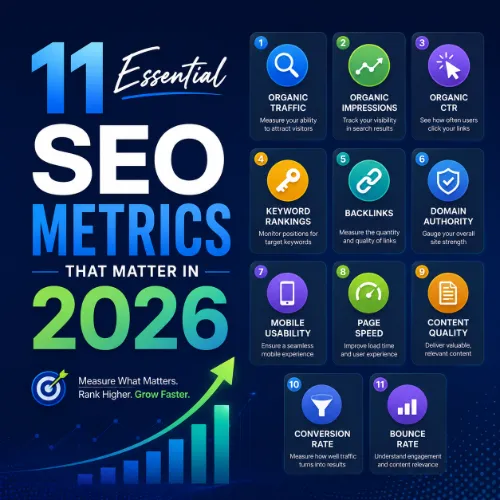
SEO used to be simpler: rank for a keyword, get traffic. In 2026, search engines understand context, intent, and entities far better. AI-generated overviews, voice search, and personalized results mean traditional metrics like total organic visits no longer tell the full story. The SEO metrics that matter in 2026 are those that connect directly to business outcomes: qualified traffic, brand trust, and sustainable authority. This listicle walks through the 11 metrics that deserve your attention now. For a related guide, see 11 Essential AI Tools for Technical SEO: Smart Solutions for 2026.
Core Web Vitals and Page Experience Signals
Google has integrated Core Web Vitals into its ranking system since 2021, but in 2026 these signals have matured. Largest Contentful Paint (LCP), First Input Delay (FID) replaced by Interaction to Next Paint (INP), and Cumulative Layout Shift (CLS) remain baseline expectations. What changed is the weighting: pages that meet all three thresholds now gain a visibility boost over those that barely pass.
Why This Matters in 2026
Mobile-first indexing and user experience are inseparable. A page with slow LCP (over 2.5 seconds) loses up to 20% of potential organic traffic. Use Google Search Console’s Core Web Vitals report to spot problem pages. Aim for all URLs to pass in the green percentile.
Branded Search Volume Growth
Branded searches are people looking specifically for your company. When this number rises, it indicates strong brand awareness and trust. In 2026, branded search volume is a leading indicator of future organic growth because search engines favor brands that earn direct queries. For a related guide, see 15 Proven Affiliate SEO Strategies for 2026 to Boost Earnings.
Trust-Building Tip
Track branded search volume in Google Search Console (average position and clicks for brand-related queries). If it declines, review your off-site reputation and consider a brand awareness campaign. A healthy brand sees 20-30% of total organic traffic from branded terms.
AI Overviews Visibility and Click Rate
In 2024, Google launched AI Overviews (formerly SGE). By 2026, these summaries occupy prime real estate on many search results. The metric to track is how often your content appears in AI Overviews and what click-through rate (CTR) those appearances generate. For a related guide, see 14 Essential Local SEO Trends for 2026: Strategies to Stay Ahead.
How to Track It
Use third-party rank tracking tools that monitor AI Overview presence. Optimize for it by writing concise, authoritative answers that directly address user questions. Over 40% of informational queries now trigger an AI Overview, so appearing there prevents traffic loss.
Organic Traffic Value (Not Just Volume)
Total organic visits can be misleading. A page ranking for “cheap gadgets” may get thousands of visits but zero conversions. Organic traffic value estimates what you would pay for that traffic via Google Ads. This SEO metrics that matter in 2026 reveal the true monetary worth of your rankings.
Practical Example
Suppose your “best running shoes” page ranks for keywords with $3.00 CPC. If it gets 5,000 monthly visits, its traffic value is $15,000 per month. Focus on pages with high traffic value, not just high traffic.
Keyword Cannibalization Rate
When multiple pages target the same keyword, they compete against each other. In 2026, Google’s entity-based algorithm penalizes internal competition because it confuses the primary page. Track how many keywords have more than one page ranking in the top 30.
Fix Strategy
Use a site:yourdomain.com search combined with a keyword to identify duplicate content. Consolidate similar pages into one authority page and set up 301 redirects from weaker versions. Tools like Ahrefs or Semrush can surface cannibalization in seconds. If you are using Ahrefs’ guide on keyword cannibalization as a reference, follow their audit steps.
Content Efficiency Index (CEI)
CEI measures how much organic traffic each article generates relative to the effort invested. In a content-saturated world, scaling ineffective content wastes budget. The formula is simple: (monthly organic visits from an article) divided by (hours spent creating and promoting it).
Why It Matters
A CEI below 10 means the article is underperforming. In 2026, efficient content strategies prioritize updates and consolidation over new pieces. Audit your top 20 posts: refresh the top 50% and merge the bottom 20% into stronger guides.
Referring Domains Quality Score
The number of referring domains (unique sites linking to you) still correlates with rankings, but quality trumps quantity. A single link from Forbes or a .edu domain can outweigh 50 low-authority links. In 2026, Google’s link spam updates penalize unnatural link profiles.
Trust-Building Tip
Check your referring domains in Google Search Console or a dedicated backlink tool. Remove or disavow toxic links from spammy directories. Focus on earning links from sites with high Domain Rating (DR) and topical relevance. For deeper analysis, Ahrefs’ backlink guide offers actionable steps.
Entity Coverage and Semantic Depth
Search engines now understand entities (people, places, things, concepts) and their relationships. Instead of just matching keywords, Google evaluates whether your page covers the full topic cluster. In 2026, pages with broader entity coverage rank higher for related terms.
How to Measure
Use tools that analyze entity density in your content. For a page about “digital marketing,” ensure you mention relevant entities like SEO, content marketing, email automation, analytics, and attribution. Compare your entity coverage against top-ranking competitor pages.
Zero-Click Search Share
Zero-click searches happen when users find answers directly on the SERP without clicking any result. Featured snippets, People Also Ask boxes, and AI Overviews dominate. In 2026, over 60% of all searches result in zero clicks. Your brand can still win visibility, but clicks may drop even if rankings stay high.
Actionable Insight
Monitor your zero-click search share in Google Search Console. If it exceeds 50% for your top pages, optimize for clicks by adding compelling meta descriptions, unique offers, or structured data that encourages visits. For transactional queries, ensure your snippet includes a call to action.
Passage Relevance Score
Passage indexing allows Google to rank specific sections of a long article. A page about “car maintenance” might rank a section about “oil change steps” even if the main keyword is different. In 2026, this metric matters because single pages can rank for dozens of long-tail queries.
Optimization Tip
Break your content into clear subsections with descriptive H2 and H3 headings. Use introductory sentences that directly answer the sub-topic query. Test with a site search for “your keyword site:yoursite.com” to see which passages already rank.
Return on Organic Investment (ROOI)
ROOI is organic traffic value divided by total SEO spend (tools, writers, links, hours). In 2026, CFOs expect SEO to prove ROI. This metric directly connects search performance to business profitability.
Simple Calculation
If your SEO spend is $5,000/month and organic traffic value is $20,000/month, your ROOI is 4:1. Aim for at least 3:1. Track it monthly and compare against paid search ROAS. When ROOI drops, either traffic value is falling or costs are rising—rebalance quickly.
SEO Entities and Their Functions
Understanding the data behind these metrics requires knowing key entities and their roles:
- Website / Domain entities: root domain, subdomain, and URL-level analysis help identify whether performance belongs to the whole site or a single page.
- Keyword entities: organic keywords, keyword difficulty (KD), search volume, and SERP features show demand and competition.
- Backlink entities: referring domains, anchor text, and follow/nofollow links reveal authority and link quality.
- Content entities: articles, topics, published dates, and social shares help evaluate editorial quality and freshness.
- Technical SEO entities: Core Web Vitals, crawl issues, and indexability status expose obstacles to ranking.
Useful Resources
For a deeper dive into tracking and analyzing these metrics, explore these trusted sources:
- Ahrefs: The Most Important SEO Metrics to Track in 2025 (and Beyond) — A comprehensive list of KPIs with examples.
- Google: AI Overviews in Search — Official documentation explaining how AI Overviews impact organic performance.
Frequently Asked Questions About SEO metrics that matter in 2026
What are the most important SEO metrics that matter in 2026?
The most important are branded search volume growth, AI Overviews visibility, organic traffic value, content efficiency index, and Core Web Vitals.
How often should I track SEO metrics in 2026?
Track high-level metrics monthly and deep-dive quarterly. Real-time metrics like Core Web Vitals should be monitored weekly.
Is organic traffic still the most important metric?
Not alone. Organic traffic value and conversion rate matter more because they tie directly to revenue. A drop in traffic may be fine if value rises.
What is the difference between organic traffic and traffic value?
Organic traffic is the number of visits; traffic value estimates the cost of that traffic if purchased via ads. Value is more actionable for business decisions.
How do I measure AI Overviews visibility?
Use rank tracking tools that specifically monitor AI Overview appearances, or manually check a sample of your target keywords.
What is a good Core Web Vitals score?
LCP under 2.5 seconds, INP under 200 milliseconds, and CLS under 0.1. All three should be in the green percentile.
How can I improve my content efficiency index?
Focus on updating and promoting existing high-potential content rather than creating new pieces. Consolidate thin articles into comprehensive guides.
Do backlinks still matter in 2026?
Yes, but quality and relevance are far more important than quantity. One strong link from a relevant site beats dozens from weak sources.
What is entity coverage in SEO?
Entity coverage means your page mentions and relates the important concepts (entities) around a topic. Search engines reward semantic depth.
How do I stop keyword cannibalization?
Identify which pages compete for the same keyword, then merge or redirect them. Use a site search with the keyword to spot duplicates.
What is a zero-click search?
A search where the user gets the answer directly on the SERP without clicking any result. Featured snippets and AI Overviews cause many zero-click searches.
Should I optimize for zero-click searches?
Yes, to secure brand visibility in snippets and AI Overviews. But also aim for snippets that include a clickable call to action.
What is passage indexing?
Google’s ability to rank individual sections of a page for relevant queries. It means longer content can earn multiple ranking positions.
How do I calculate ROOI?
Divide your organic traffic value by total SEO spend (tools, writers, links, hours). A ROOI of at least 3:1 is considered healthy.
Is brand search volume a leading indicator?
Yes. When branded searches rise, it usually predicts future organic growth because Google rewards recognized brands.
What tools help track these metrics?
Google Search Console for basic data, plus Ahrefs or Semrush for deeper backlink, keyword, and competitor analysis.
How often should I conduct an SEO audit?
At least quarterly. A full audit checks Core Web Vitals, cannibalization, backlinks, content efficiency, and zero-click share.
What is the most overlooked metric in 2026?
Content efficiency index. Many teams focus on volume instead of evaluating which content earns its creation cost.
Does voice search affect which metrics to track?
Yes. Voice queries are more conversational and local, so track phrase-based keywords and local pack appearances if relevant.
What is the first metric to fix if rankings drop?
Check Core Web Vitals and indexability first, as technical issues often cause sudden drops. Then review backlink changes.