
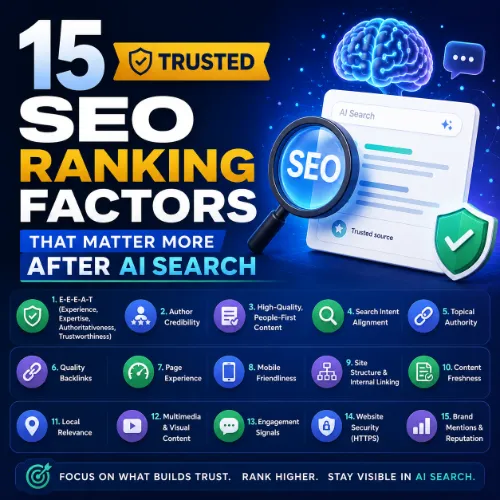
SEO ranking factors after AI search Key Takeaways
AI search has reordered the SEO ranking factors after AI search , shifting emphasis from sheer keyword density to concepts like EEAT, topical authority, and user intent.
- Topical authority and structured data now outrank generic backlink counts in many AI SERPs.
- Search engines evaluate user engagement signals like click-through rate, dwell time, and direct visits more heavily.
- Trustworthy, cited content that satisfies multipart queries earns AI Overview placements and featured snippet expansion.
How Trusted SEO ranking factors after AI search Have Shifted
AI search models — from Google’s Search Generative Experience (SGE) to Bing Copilot and other AI-powered assistants — don’t scan pages the same way traditional algorithms did. Instead of matching keyword strings, these models evaluate conceptual relevance, factual consistency, and source reliability. The result is a new hierarchy of signals that rewards depth, proof, and genuine utility. For a related guide, see 8 Content Types AI Search Loves: Essential SEO Guide for Higher Rankings.
Understanding which SEO ranking factors after AI search matter most helps you invest effort where it will actually move your rankings.
The 15 SEO ranking factors after AI search That Matter Most
1. Topical Authority (Not Just Keyword Coverage)
AI search engines evaluate a site’s topical authority by analyzing the breadth and depth of content across a subject area. A page about “best running shoes” ranks better if your site also covers shoe anatomy, running technique, and foot health. Build topic clusters with pillar pages and supporting articles to demonstrate expertise.
2. Structured Data and Entity Markup
Schema markup helps AI models parse your content as entities, not just words. Use FAQ, HowTo, Product, and Article schema to clearly label your content. Rich snippets generated from schema also increase click-through rates, which feeds back into ranking signals. Google’s structured data guide offers a solid starting point.
3. Authentic Backlinks from Authoritative Niches
AI models weigh referring domains more contextually. A link from a high-DR site in your niche is worth more than ten generic links. Focus on earning links through original research, expert quotes, and useful tools that niche sites will naturally reference. For a related guide, see 15 AI SEO Tools Worth Trying in 2026: Expert Picks.
4. User Engagement and Dwell Time
When searchers click your result and stay on the page for more than a few seconds, AI interprets that as a signal of relevance. Use clear headings, scannable lists, and multimedia to keep visitors engaged. High bounce rates suggest your content didn’t match intent.
5. Direct Brand Searches and Navigational Queries
AI models monitor brand-level signals. A rise in branded search queries (e.g., “Ahrefs blog” or “Moz guide”) tells the engine your brand is trusted. Invest in brand awareness through PR, social media, and community participation.
6. Content Freshness and Update Frequency
AI prefers recent sources, especially for time-sensitive topics. Regularly update statistical content, add new examples, and republish improved articles. Freshness is a ranking factor that gains importance when AI verifies facts against current dates.
7. Page Experience and Core Web Vitals
While not the strongest signal, good Core Web Vitals (LCP, INP, CLS) reduce friction. AI models are less likely to feature slow-loading pages in answer boxes or SERP features. Optimize images, leverage caching, and minimize JavaScript for a smooth experience.
8. Answer Completeness and Multipart Intent
AI queries often combine multiple sub-questions. A single page that answers “What is AI search?” and “How do I optimize for it?” in a structured way outperforms separate pages. Cover related entities and subtopics within one article.
9. Source Citations and Factual Accuracy
Reference authoritative external sources and cite data. AI models are trained to recognize trustworthy citations (e.g., government stats, academic papers). Pages with verifiable sources rank higher for informational queries.
10. Internal Linking and Site Architecture
AI models follow internal links to understand content hierarchy. Use descriptive anchor text and link between related posts. A well-structured internal linking plan helps distribute page authority and clarifies topical clusters.
11. Brand Mentions (Even Unlinked)
Unlinked brand mentions signal real-world authority. Tools like Ahrefs Alerts or Google Alerts can track these. When you find unlinked mentions, outreach to convert them into backlinks.
12. Multimedia and Structured Content
AI can process images, videos, charts, and tables. Incorporate original graphics, embed relevant YouTube clips, and use tables for comparisons. This aids both user comprehension and AI extraction.
13. Social Signals and Content Distribution
While not direct ranking factors, strong social shares correlate with visibility. Content that earns traction on LinkedIn, Reddit, or X often accumulates backlinks and engagement that AI models weigh.
14. Long-Form Comprehensive Content
AI models reward content that thoroughly covers a topic. Articles of 2,000+ words that include examples, lists, and expert insights tend to perform better for generative answers. Focus on value, not word count alone.
15. Author EEAT and Author Authority
Author bios, credentials, and bylines matter more because AI can identify experts. Include an author box with credentials, link to author profiles, and maintain EEAT (Experience, Expertise, Authoritativeness, Trustworthiness) signals such as external citations and portfolio links.
How to Prioritize These SEO ranking factors after AI search
Not every factor matters equally for every site. A local business should prioritize direct brand searches and internal linking more than a news site would. Conduct a content gap audit, review your top competitors with tools like Ahrefs or Moz, and decide which 3–5 factors will move your needle this quarter.
SEO Entities and Their Functions
Understanding the entities behind ranking analysis helps you interpret data correctly. Here are the most relevant for SEO ranking factors after AI search:
- Referring domains: The number of unique websites linking to yours. Quality matters more than quantity after AI updates.
- Keyword difficulty (KD): A metric (often 0–100) that estimates how hard it is to rank for a query. KD is less predictive for AI overviews, but still useful for traditional SERPs.
- Organic traffic value: Estimated monthly value if the traffic came via paid search. Helps prioritize high-opportunity keywords.
- Core Web Vitals: LCP (loading), INP (interactivity), CLS (layout shift). Affects page experience, a secondary but non-optional factor.
- Featured snippets: Direct answer boxes that AI often repurposes in generative results. Optimizing for snippets can increase visibility in AI search.
Useful Resources
- Ahrefs: SEO Ranking Factors Study 2025 — Data-backed analysis of which signals correlate with top rankings.
- Google SEO Starter Guide — Official guidance on fundamental SEO practices that remain relevant for AI search.
Conclusion
The SEO ranking factors after AI search reward depth, proof, and genuine user value. Traditional SEO tactics like keyword stuffing are irrelevant; instead, invest in topical authority, structured data, user engagement, and quality backlinks. Start by auditing your current content for these 15 factors and prioritize improvements that align with your niche and audience needs.
Frequently Asked Questions About SEO ranking factors after AI search
What are the most important SEO ranking factors after AI search?
Topical authority, structured data, user engagement, and authentic backlinks are the most influential SEO ranking factors after AI search.
Does keyword density still matter in AI-driven SEO?
Keyword density matters far less; AI models assess concept coverage and synonyms. Use keywords naturally, but focus on covering the topic comprehensively.
How does Google’s SGE affect traditional ranking factors?
SGE reduces the emphasis on exact-match keywords and increases the importance of EEAT, factual accuracy, and multipart answer formatting.
Are backlinks still a strong ranking signal?
Yes, but AI models evaluate the contextual relevance of the linking site more strictly. A few high-authority, niche-relevant links outperform many generic ones.
What role does user engagement play in AI search rankings?
Engagement signals like click-through rate, dwell time, and low bounce rate indicate content relevance and can influence ranking positions.
How can I optimize for AI Overviews?
Create clear, structured answers to common questions. Use header tags, bullet points, and schema markup for FAQ and HowTo content.
Does page speed matter more after AI search updates?
Page speed remains a baseline requirement, not a top differentiator. Core Web Vitals are necessary but not sufficient for top rankings.
What is topical authority and how do I build it?
Topical authority is demonstrating expertise across a subject area. Build it by creating pillar pages, cluster content, and linking them logically.
Should I still do keyword research for AI search?
Yes, but focus on question-based and long-tail keywords that reflect conversational search. Also research entity associations and related topics.
How does AI detect content quality?
AI evaluates readability, factual consistency, citations, depth, and user engagement patterns. Thin or plagiarized content is easily flagged.
Is internal linking still important for SEO ranking factors after AI search?
Yes, internal linking helps AI understand site structure and distribute authority. Use descriptive anchor text and link to relevant cluster pages.
What type of content performs best in AI search results?
Well-structured, long-form content that answers multipart questions with examples, statistics, and cited sources performs best.
Do social shares directly affect AI search rankings?
No, but social distribution often leads to backlinks and increased engagement, which indirectly benefit rankings.
How do I improve my site’s EEAT signals?
Display author credentials, include external citations, update content regularly, and earn links from authoritative sources in your niche.
What is the role of structured data in AI-powered search?
Structured data helps AI correctly interpret entities, attributes, and relationships. Schema markup can also trigger rich results that improve CTR.
Does domain age matter after AI search updates?
Domain age is a minor factor; trust and topical authority carry more weight. New domains can rank well if they demonstrate subject expertise quickly.
How can I track my SEO ranking factors after AI search?
Use tools like Ahrefs, Semrush, or SE Ranking to monitor keyword positions, backlink growth, and SERP feature appearances.
What is the biggest change in SEO ranking factors after AI search?
The shift from keyword matching to intent and concept understanding is the biggest change, making comprehensive, well-sourced content essential.
Can I use AI writing tools for AI search optimization?
Yes, but always fact-check and personalize AI-generated drafts. Search engines can detect pure AI content lacking human insight or nuance.
How often should I update my SEO strategy for AI search?
Review your strategy quarterly and monitor major algorithm updates. AI search evolves quickly, so staying informed through industry blogs and webinars is key.