
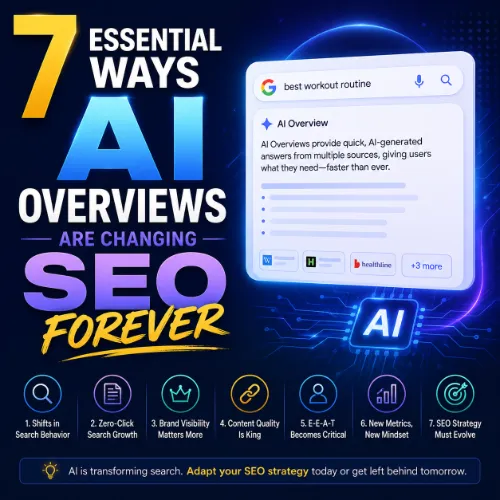
AI overviews changing SEO Key Takeaways
The rise of AI-generated summaries in search results is fundamentally altering how websites earn visibility.
- AI overviews changing SEO demands a focus on structured content that answers user intent concisely, rather than just targeting keywords.
- Sites must optimize for snippet extraction and featured positions within AI summaries to maintain traffic volumes.
- Building topical authority and earning trust signals like backlinks and positive reviews is more critical than ever for inclusion in AI-generated responses.
Why AI overviews changing SEO Matters for Every Website Owner
The way people search is evolving. Instead of scrolling through a list of blue links, users now often see a synthesized answer at the top of the page, generated by artificial intelligence. This shift, driven by Google’s Search Generative Experience (SGE) and similar features, means that being the top organic result is no longer enough. You must also be the source that the AI trusts to summarize. For a related guide, see 13 AI Search Behaviors That Changed: Smart User Insights.
For professionals managing websites, this change introduces both a threat and an opportunity. The threat is a potential drop in referral traffic if your content is used without a click. The opportunity is that appearing in an AI Overview can position your brand as the definitive authority on a subject, driving brand recognition and future visits. Understanding these dynamics is the first step to protecting your search visibility.
1. Zero-Click Searches Become the Norm
AI overviews changing SEO directly impacts click-through rates. When Google provides a comprehensive answer in an AI summary, many users find what they need without ever clicking a link. This trend, often called zero-click search, is accelerating rapidly.
For informational queries like “how to tie a tie” or “symptoms of dehydration,” the AI often pulls from multiple sources to create a single, authoritative paragraph. As a result, websites that previously relied on these questions for traffic may see a significant decline. Adapting means focusing on queries where the AI cannot provide a complete answer—such as those requiring recent data, localized information, or personal opinion.
What You Can Do
Focus on creating content that drives transactional or deep-navigation intent. For example, instead of writing a generic “best coffee machines,” create a comparison table with recent prices and availability that the AI cannot easily replicate. Ensure your product pages are rich with structured data to appear in shopping results.
2. Structured Data and Schema Markup Are Non-Negotiable
To feed AI Overviews accurate information, Google relies heavily on structured data. AI overviews changing SEO means that implementing schema markup is no longer optional—it is a requirement for being considered a trusted source. Review schema, FAQ schema, HowTo schema, and Article schema help the AI understand the context and credibility of your content.
For instance, a recipe site using Recipe schema with clear step-by-step instructions and cooking times is far more likely to be cited in an AI Overview than a plain HTML page without markup. Similarly, a local business using LocalBusiness schema and collecting verified reviews on Google will be preferred for local queries.
Practical Schema Checklist
- Implement Article or NewsArticle schema on blog posts.
- Add FAQ schema to pages with common questions.
- Use Product schema with price and availability on e-commerce pages.
- Include HowTo schema for instructional content.
- Verify your structured data with Google’s Rich Results Test.
3. Authority and Expertise Are More Important Than Ever
Google’s AI prioritizes sources it deems authoritative. This means that AI overviews changing SEO favors established brands, recognized experts, and sites with strong backlink profiles. The days of a thin affiliate site ranking for “best laptop” without real expertise are numbered.
The AI uses signals like the author’s credentials, publication history, and the overall topical authority of the website. A blog post written by a certified nutritionist will outrank a generic article on the same topic, even if the generic article has better on-page SEO. Building a personal brand or a team of experts is a long-term strategy that pays off in the AI era.
4. Content Must Be Concise and Direct
AI models extract snippets from your text to form summaries. Therefore, your writing style must adapt. AI overviews changing SEO rewards clear, direct answers at the top of your article. If you bury the answer to a user’s query in the fifth paragraph, the AI might skip your content entirely.
Use a clear heading that matches the question, followed by a short paragraph that provides the answer. For example, if your article covers “how to clean a cast iron skillet,” start with a bold answer like “The best way to clean a cast iron skillet is to scrub it with coarse salt and a paper towel while it is still warm.” This structure makes it easy for the AI to pick your content for a featured summary.
5. Visual and Multimedia Content Gain New Value
AI Overviews are not limited to text. Google is increasingly incorporating images, videos, and even audio clips into its generated answers. AI overviews changing SEO means that optimizing your images with descriptive alt text and structured captions can help you appear in these visual elements.
For a travel article, a well-labeled photo of a landmark with the correct geotag can be used by the AI to answer “what does the Eiffel Tower look like at sunset?” Similarly, embedding YouTube videos with transcripts can increase the chance of your content being selected for video results within the AI Overview.
6. Long-Tail Keywords and Conversational Queries Rise
AI models are designed to understand natural language. This shift means that AI overviews changing SEO favors content that matches the way people actually speak. Instead of targeting “best running shoes,” you should also target “what are the best running shoes for flat feet in 2025?”
Conduct keyword research focusing on question-based queries and long-tail phrases. Use tools like Google’s “People Also Ask” feature and Ahrefs’ Keyword Explorer to find these conversational terms. Then, create dedicated sections or FAQ entries that answer each variation directly.
7. The Need for Freshness and Recency
AI Overviews often prioritize the most up-to-date information, especially for topics like news, prices, and product availability. AI overviews changing SEO means that stale content is unlikely to be featured. Regularly updating your articles with new data, recent statistics, and current prices is essential.
Set up a content audit schedule. For each core page, update the publish date, refresh examples, and add any new developments. For news-related content, speed matters—publishing quickly and accurately improves your chances of being cited in the AI summary before competitors.
SEO Entities and Their Functions
Understanding the building blocks of SEO is essential for adapting to AI Overviews. Here’s how key entities help with analysis and decision-making.
- Website / Domain entities: Analyzing root domain, subdomain, and URL-level performance helps identify whether authority is site-wide or page-specific. AI prefers whole-site authority for broad queries.
- Keyword entities: Organic keywords, keyword difficulty, search volume, and SERP features show demand and competition. Focus on low-competition, high-intent keywords that AI may cite.
- Backlink entities: Referring domains, dofollow/nofollow links, and new/lost backlinks reveal link quality and outreach priorities. A strong backlink profile boosts inclusion in AI summaries.
- Content entities: Articles, authors, topics, and social shares help evaluate editorial quality. Content from recognized authors is more likely to be trusted by AI.
- SERP entities: Featured snippets, People Also Ask, and AI Overviews show what format the search result rewards. Structure your content to match these formats.
- Technical SEO entities: Crawl issues, redirect chains, and Core Web Vitals expose obstacles that prevent indexing. A technically sound site is easier for AI to parse.
Useful Resources
For deeper reading on how AI is reshaping search, check out these resources:
- Google’s Search Gallery — Understand how AI Overviews and other search features appear in results.
- Ahrefs Blog: AI Overviews and SEO — Practical strategies for adapting your content strategy based on data-driven insights.
Frequently Asked Questions About AI overviews changing SEO
Frequently Asked Questions About AI overviews changing SEO
What is an AI Overview in search results?
An AI Overview is a generated summary that appears at the top of Google search results, synthesizing information from multiple sources to answer a user’s query directly without requiring a click.
How are AI overviews changing SEO in 2025?
They are reducing organic click-through rates for informational queries, increasing the importance of structured data and authority signals, and shifting focus toward creating concise, directly answerable content.
Will AI Overviews kill organic traffic?
Not entirely. While zero-click searches are rising, transactional and branded queries still drive clicks. The key is to diversify your content strategy to include comparison, review, and location-based pages that require a visit.
How can I optimize my content for AI Overviews?
Focus on clear, direct answers to common questions, use proper heading hierarchy (H2, H3), implement structured data markup, and build topical authority by covering related subtopics in depth.
Does schema markup guarantee inclusion in AI summaries?
No, but it significantly increases the likelihood. Schema helps the AI understand your content’s context, making it easier to extract relevant information for synthesis.
Are backlinks still important for SEO with AI Overviews?
Yes, backlinks remain a strong authority signal. Google’s AI considers the overall trustworthiness of a domain, and a robust backlink profile is a key indicator of quality.
What types of content are most likely to appear in AI Overviews?
Informational content that answers a specific question with a concise answer, such as definitions, step-by-step guides, and factual lists, currently has the highest chance of being featured.
How does Google choose which sources to use for an AI Overview?
Google uses a combination of relevance, authority, freshness, and user experience signals. Sources with high-quality backlinks, strong domain reputation, and recent updates are preferred. For a related guide, see 15 Proven Link Building Strategies Still Working in 2026.
Should I write shorter articles now because of AI summaries?
Not necessarily. Short answers are good for snippets, but long-form content that covers a topic comprehensively is still valuable. The key is to front-load the answer and then provide deeper value.
Can AI Overviews include images from my site?
Yes. Google may include images from your site if they are relevant and properly optimized with descriptive alt text and structured captions. High-quality original visuals are best.
How often are AI Overviews updated?
Update frequency varies. For breaking news, summaries may update within minutes. For static topics like historical facts, they may remain unchanged for months. Regular content updates help.
Do AI Overviews hurt local SEO?
They can affect local informational queries, but local pack results and map listings remain separate. Optimizing your Google Business Profile and gathering local reviews is still crucial.
What is the difference between a featured snippet and an AI Overview?
A featured snippet is a single extracted text block from one page. An AI Overview synthesizes information from multiple sources to create a new, unique answer.
How do I check if my site appears in AI Overviews?
You can manually search for your target queries and look for the AI-generated summary. Tools like Ahrefs’ Site Explorer and Google Search Console may also show impressions for generative search features.
Should I block AI from using my content?
You can use the “nositelinkssearchbox” or robots.txt directives to limit how Google uses your content, but blocking may hurt your visibility. Most experts recommend allowing use to benefit from brand exposure.
Are AI Overviews available in all countries?
As of 2025, AI Overviews are rolling out globally but are fully available in English-speaking countries and some European markets. Availability continues to expand.
How do AI Overviews affect e-commerce SEO?
For product-related queries, AI Overviews may show comparison tables or summaries. Ensure your product data is accurate and structured with Product schema to increase the chance of being included.
Can I optimize for video in AI Overviews?
Yes, adding video transcripts and using VideoObject schema can help your video content be featured within AI summaries, especially for how-to and review queries.
What is the future of SEO with AI Overviews?
SEO will become more about building brand authority and trust rather than just ranking for keywords. Content quality, user engagement, and ethical link building will remain the cornerstones of success.
How long does it take to see results from AI Overview optimization?
It varies. Some sites see inclusion within weeks after optimizing structure and schema, while others may take months. Consistency and authority building are key factors.