
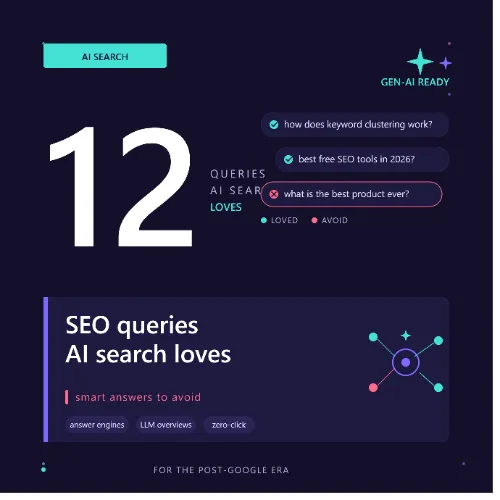
SEO queries AI search loves Key Takeaways
AI search engines favor queries that demonstrate clear intent, authoritative answers, and structured data.
- AI rewards concise, well-structured answers that directly satisfy user intent.
- Focus on natural language and conversational phrasing, mirroring how people actually ask questions.
- Include semantic entities and relevant context to help AI models understand your expertise.
Why SEO Queries AI Search Loves Matter for Your Rankings
AI-powered search engines like Google SGE, Bing Chat, and Perplexity analyze content differently than traditional algorithms. They prioritize content that clearly answers a query, uses trustworthy sources, and includes structured data. When you align your content with the SEO queries AI search loves, you increase your chances of appearing in AI-generated summaries and voice responses. For a related guide, see 15 Trusted SEO Ranking Factors That Matter More After AI Search.
The key is to shift from keyword stuffing to intent-driven writing. AI models look for context, entity relationships, and natural language patterns. If your content reads like a helpful expert speaking directly to the reader, AI search engines will reward it. For a related guide, see 11 AI SEO Experiments: Smart Ways to Boost Your Rankings.
The 12 SEO Queries AI Search Loves and How to Answer Them
Below are the 12 query types that AI search engines particularly favor. For each, we explain why AI loves it and how to craft a smart, trustworthy answer.
1. “How to [do something]” Step-by-Step Queries
AI search engines favor procedural queries because they often produce snippet-friendly results. Answer with numbered steps, clear verbs, and practical examples. For instance, “How to optimize meta descriptions for SEO” should list exact character limits, including keywords naturally, and include a before-and-after example.
2. “What is [topic]” Definition Queries
Definitions are the backbone of featured snippets and AI Overviews. Provide a concise, authoritative definition in the first paragraph, then expand with examples. Use the focus keyword in the opening sentence, such as: “SEO queries AI search loves are question formats that align with how AI models extract and summarize information.”
3. “[Topic] vs [Topic]” Comparison Queries
AI loves comparison queries because they often trigger table snippets. Use a clear comparison table with rows for criteria, pros, and cons. For example, “Ahrefs vs SEMrush for keyword research” works well when you list features, pricing, and best use cases side by side.
4. “Why [something happens]” Causal Queries
Explanatory queries that explore cause and effect are gold for AI. Structure your answer with a bold claim, followed by evidence. For instance, “Why does Google prefer long-form content?” — answer with algorithm updates, user engagement metrics, and quoting a study from Search Engine Land.
5. “When [something should be done]” Timing Queries
Timing-related queries often appear in AI Overviews for seasonal content. Provide specific months, frequency recommendations, and warning signs. For example, “When should you update your SEO strategy?” — answer with quarterly reviews, algorithm update cycles, and competitor shifts.
6. “Which [product/service] is best for [use case]” Recommendation Queries
AI loves recommendation queries because they often generate listicles with product images. Use a numbered list with clear criteria and a comparison table. Always include a disclaimer that results vary, and link to primary sources.
7. “[Problem] symptoms and fixes” Diagnostic Queries
These queries are common in SEO (e.g., “sudden traffic drop symptoms and fixes”). AI search engines favor diagnostic content because it offers immediate value. List symptoms, then provide a flowchart-style solution path. Use bullet points for symptoms and numbered steps for fixes.
8. “How much does [service] cost” Pricing Queries
Price queries often trigger AI Overviews with ranges and averages. Provide realistic cost brackets, factors that influence pricing, and examples of what you get for each tier. Always include a table with low, mid, and premium ranges.
9. “[Location] best [business type]” Local SEO Queries
Local queries with city names are heavily used in AI search. Include the city and state naturally in headings and body text. List specific businesses, their ratings, and what makes each unique. Use structured data (LocalBusiness schema) to help AI extract details.
10. “Who is [person]” Biography Queries
Biographical queries often trigger knowledge panels. Start with a one-paragraph summary of who the person is, what they are known for, and why they matter. Use a bulleted timeline of key events. Link to authoritative sources like Wikipedia or official websites.
11. “What are the benefits of [something]” Benefits Queries
AI search engines love benefit-driven queries because they often appear in bulleted snippets. List 5–7 benefits with a brief explanation for each. Use the focus keyword in the introductory paragraph, for example: “Understanding which SEO queries AI search loves helps you create benefit-rich content that ranks.”
12. “[Year] trends in [topic]” Trend Queries
Trend queries with a specific year are especially favored by AI because they indicate freshness. Include a table of trends with years, brief descriptions, and examples. Link to credible trend reports from Google or industry publications.
SEO Entities and Their Functions
To create content that AI search engines trust, you need to understand and use the right entities. Below are key entities and what they do for analysis and decision-making.
- Website / Domain entities: Root domain, subdomain, and URL-level analysis identify whether performance belongs to the whole site, a section like blog.example.com, or a single page such as example.com/page.
- Keyword entities: Organic keywords, paid keywords, keyword difficulty (KD), search volume, CPC, traffic potential, and SERP features show demand, competition, paid value, ranking opportunity, and result-type requirements.
- Backlink entities: Referring domains, referring pages, anchor text, dofollow/nofollow links, broken backlinks, and new/lost backlinks explain authority, link quality, link risk, and outreach priorities.
- SERP entities: Featured snippets, People Also Ask, sitelinks, AI Overviews, video results, and local packs show what content format and answer structure the search result rewards.
- Technical SEO entities: Crawl issues, redirect chains, canonicals, duplicate content, Core Web Vitals, and indexability status expose obstacles that prevent crawling, ranking, or a good page experience.
How to Identify Which SEO Queries AI Search Loves for Your Niche
Start by researching your target keywords using a tool like Ahrefs Keyword Generator. Filter for question-based queries with high search volume and low competition. Then, analyze the current SERP — if you see featured snippets, People Also Ask boxes, or AI Overviews, those queries are prime candidates.
Use the 12 query types above as a checklist. For each page you create, ask: does this content fit one of these types? If yes, tailor your structure and formatting to match what AI loves.
Common Mistakes to Avoid When Targeting SEO Queries AI Search Loves
- Keyword stuffing: AI models penalize unnatural repetition. Use synonyms and related entities instead.
- Ignoring user intent: If the query is informational, don’t write a sales pitch. Serve the intent first.
- Thin content: AI search engines require depth. Expand each answer with examples, data, and expert sources.
- Missing structured data: Schema markup helps AI extract and display your content in rich results.
Useful Resources
For deeper research on how AI search engines evaluate content, check out these resources:
- Google AI Overviews Documentation — official guidelines on how Google creates AI-powered search results.
- Search Engine Journal’s AI Search Optimization Guide — practical tips for optimizing content for AI-driven search.
Frequently Asked Questions About SEO queries AI search loves
What are SEO queries AI search loves?
They are specific question formats and search query types that AI-powered search engines favor, such as “how to,” “what is,” comparison, and diagnostic queries. Aligning content with these helps improve visibility in AI Overviews and featured snippets.
Why do AI search engines love certain queries?
AI loves queries that have clear intent, structured answers, and high-authority sources. These queries often trigger rich results like snippets, tables, and lists, making the AI’s output more useful.
How many types of SEO queries does AI favor?
There are 12 primary types: how-to, definition, comparison, causal, timing, recommendation, diagnostic, pricing, local, biography, benefits, and trend queries.
Can I use the same format for all 12 queries?
No. Each query type has a preferred structure. For example, how-to queries need numbered steps, while comparison queries work best with a table. Tailor your format to the query type.
Do AI search engines prefer short or long answers?
AI prefers concise, direct answers for snippets, but rewards depth for comprehensive coverage. Aim for a short answer at the top, followed by deeper explanation.
How do I find which queries AI currently loves?
Use keyword research tools and analyze the SERP for AI Overviews, People Also Ask, and featured snippets. Queries that trigger those results are ones AI loves.
Is voice search related to AI query preferences?
Yes. Voice search queries are typically longer and more conversational, matching the natural language style that AI models are trained on.
Should I target only one query type per page?
It’s better to focus on one primary query type per page to keep the content focused and authoritative. You can address related sub-questions within the same page.
Do AI search engines use schema markup?
Yes. Schema markup, especially FAQ, HowTo, and QAPage schemas, helps AI understand and extract your content more accurately.
How often do AI search query preferences change?
They evolve as AI models update. Major search engines like Google refresh their algorithms quarterly, so stay informed with industry news.
Can local businesses benefit from AI query optimization?
Absolutely. Local SEO queries like “best pizza in Chicago” are highly favored by AI for local pack and AI Overview results.
What is the best tool for AI query research?
Ahrefs and SEMrush are strong choices. Use their keyword tools to filter for question-based queries and analyze SERP features.
How do I know if my content is optimized for AI search?
Check if your pages trigger AI Overviews or featured snippets. Use Google Search Console to see impressions and click-through rates for those queries.
Do AI search engines consider backlinks?
Yes. Backlinks remain a strong authority signal. AI models still rely on link-based metrics to assess trustworthiness.
Is it worth updating old content to match AI query preferences?
Yes. Updating older posts with structured answers, fresh data, and schema markup can revive their visibility in AI-powered search features.
Should I use the exact focus keyword in every heading?
No. Use the focus keyword naturally in at least two H2s and the first paragraph, but rely on LSI keywords and related entities for the rest.
Can I target multiple AI-friendly queries in one article?
Yes, if they are closely related. For example, a guide can include a “how to” section, a “what is” definition, and a “vs” comparison — each with its own format.
How long should a typical AI-optimized page be?
Aim for 800–1,200 words for normal expansion, and up to 2,000 for deeper coverage. Depth matters, but so does conciseness.
Do AI search engines penalize affiliate content?
Not inherently, but they prefer objective, helpful content over pure sales pitches. Add original research, user reviews, and clear disclaimers.
What is the single most important factor for AI search ranking?
Clear, direct answers that match user intent — backed by authoritative sources and structured data — is the most critical factor.