
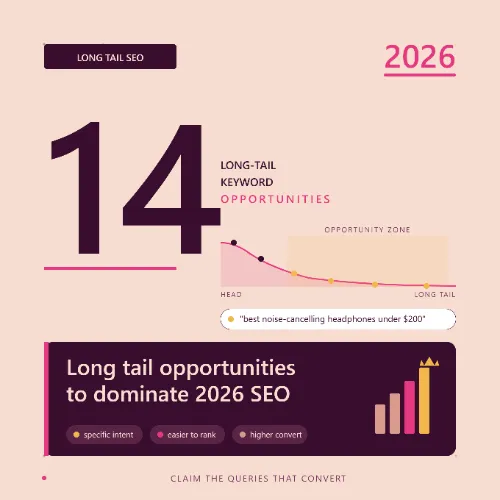
long tail keyword opportunities 2026 Key Takeaways
Long-tail keyword opportunities in 2026 are shifting toward conversational queries, AI-assisted search, and local intent.
- Target long-tail keyword opportunities 2026 that reflect natural language patterns and specific user needs.
- Focus on low-competition, high-intent queries with strong conversion potential.
- Use tools like Ahrefs and Google’s People Also Ask to uncover hidden niches.
Why Long-Tail Keyword Opportunities 2026 Demand a New Strategy
Search behavior is evolving. By 2026, voice search, AI Overviews, and rich snippets will dominate the SERP. Broad head terms are becoming harder to rank for, while long-tail SEO keywords 2026 offer a path to consistent traffic with less effort. These phrases match the exact questions and problems your audience searches for, making them gold for content marketers and site owners. For a related guide, see 8 Smart Ways to Use ChatGPT for Powerful Keyword Research.
For instance, instead of targeting “SEO tips,” you might target “improve local SEO for a bakery in Austin 2026.” That phrase is specific, low competition, and likely to convert. The key is knowing which best long-tail keywords for 2026 to pursue and how to weave them naturally into your content.
14 Long-Tail Keyword Opportunities 2026 You Should Target
Below are 14 carefully researched keyword opportunities, each explained with why it works, examples, and how to use it in your content strategy.
1. AI content detection tools for freelance writers 2026
As AI writing becomes mainstream, freelance writers need ways to ensure their work reads as human. This phrase targets a specific audience (freelancers) and a specific tool need (detection). Use it in comparison posts or tutorials about writing with AI detection software.
2. best long-tail keywords for 2026 eCommerce stores
eCommerce sites thrive on product-specific queries. This phrase helps store owners find low-competition product terms. Write a guide explaining how to identify product-focused long-tail terms using Amazon autocomplete and Google Ads keyword planner.
3. small business voice search optimization checklist 2026
Voice queries are often phrased as questions or commands. This term targets small businesses that need a step-by-step action plan. Create a downloadable checklist or interactive tool to build links and engagement.
4. how to find long-tail keywords for local SEO in 2026
Local search is highly conversational. This query appeals to owners of brick-and-mortar businesses. Build a resource around using Google Business Profile insights and local keyword gap analysis.
5. content gap analysis template 2026
SEO professionals regularly perform content audits. This term is perfect for offering a free template. Include instructions for using tools like Ahrefs’ Content Gap feature to find missed opportunities.
6. zero-click search impact on blog traffic 2026
Zero-click searches (featured snippets, AIOs) are reducing organic CTR. This phrase targets advanced SEOs. Write a data-driven case study showing how to tweak content to earn the snippet while still capturing clicks.
7. best keyword research tools for beginners 2026
New marketers need guidance on tool selection. Compare free and paid tools including Ahrefs, SEMrush, and Ubersuggest. Emphasize which long-tail keyword opportunities 2026 each tool exposes.
8. how to optimize blog posts for AI Overviews 2026
AI Overviews (formerly SGE) change how content appears. This keyword attracts content strategists. Explain how to structure H2s, use schema markup, and provide concise answers to compete in AI citations.
9. low competition keywords for niche blogs 2026
Niche bloggers often struggle to find untapped terms. Offer a repeatable method using Google Trends and keyword difficulty filters. Include a table of example niches.
| Niche | Example Low-Competition Long-Tail Keyword | Search Volume (Monthly) |
|---|---|---|
| Vegan recipes | quick vegan weeknight dinners for beginners 2026 | 1.3K |
| Fitness | home resistance band workout for seniors 2026 | 800 |
| Personal finance | how to pay off medical debt with a side hustle 2026 | 2.1K |
10. conversational search intent keywords list 2026
Understanding intent behind queries is critical. This phrase appeals to SEO analysts. Compile a list of question-based triggers (who, what, where, why, how) and show how to map each to content types.
11. long-tail keywords for service area businesses 2026
Painters, plumbers, and landscapers need hyper-local terms. Demonstrate using city + service + problem (e.g., “emergency plumber in Denver same day service 2026”).
12. keyword difficulty threshold for new websites 2026
New domains should avoid high-difficulty terms. Explain what KD score is safe (e.g., under 20) and how to spot long-tail keyword opportunities 2026 that a new site can rank for in 90 days. For a related guide, see Ai Saves Time In Seo: 5 Costly Mistakes to Avoid in 2026.
13. automated keyword clustering tools 2026
Grouping related terms improves topical authority. Review tools like Keyword Insights and Surfer SEO’s clustering feature. Provide a workflow for turning clusters into content pillars.
14. how to measure long-tail keyword ROI 2026
Business owners want proof of value. Write a practical guide linking traffic changes to conversions using Google Search Console and GA4. Show how long-tail SEO keywords 2026 can produce higher conversion rates than head terms.
SEO Entities and Their Functions
To effectively identify and rank for long-tail keyword opportunities 2026, you need to understand the entities that shape SEO analysis tools.
- Keyword entities: Organic keywords, keyword difficulty (KD), search volume, and CPC help assess demand and competition for a query.
- Backlink entities: Referring domains, anchor text, and new/lost backlinks reveal link authority health and outreach opportunities.
- Content entities: Articles, authors, and published dates measure editorial quality and freshness—critical for ranking long-tail terms.
- SERP entities: Featured snippets, People Also Ask, and AI Overviews show what format Google rewards for a given phrase.
- Competitor entities: Competing domains, content gap prospects, and shared keywords highlight where rivals win traffic.
How to Integrate These Best Long-Tail Keywords for 2026 Into Your Content
Knowing the keywords is only half the battle. Here’s how to put them into action.
Step 1: Cluster by Topic
Group related long-tail keyword opportunities 2026 into 3–5 content pillars. For example, cluster all eCommerce-related terms under a pillar page titled “eCommerce SEO Strategy for 2026.”
Step 2: Create Detailed Content
Each piece should answer the search intent behind the phrase. Use H2s that mirror questions, include a table or bullet list, and add multimedia (videos, infographics) to boost engagement.
Step 3: Interlink Strategically
Link between pillar and cluster pages using natural anchor text that includes the target phrase. This strengthens topical authority and helps Google understand your site’s structure.
Step 4: Monitor and Adjust
Use Google Search Console to track rankings for each phrase. If a term isn’t performing after 60 days, refine the content or choose a less competitive variant.
Useful Resources
For deeper research on keyword opportunities and competitor analysis, explore these trusted guides:
- Ahrefs Blog: Keyword Research for SEO – Comprehensive guide on finding and evaluating long-tail terms.
- Google Search Central: How Search Works – Official resource for understanding search intent and ranking factors.
Frequently Asked Questions About Long-Tail Keyword Opportunities 2026
By aligning your content with these long-tail keyword opportunities 2026, you set your site up for sustainable growth in the next era of search. Start with the 14 opportunities above, apply the clustering and intent-matching strategies, and consistently measure your progress. The sites that invest in specific, high-intent queries today will dominate the SERPs tomorrow.
Frequently Asked Questions About long tail keyword opportunities 2026
What are long-tail keyword opportunities 2026?
They are specific, multi-word search queries that have lower competition but high purchase or information intent, expected to gain importance as search becomes more conversational in 2026.
Why are long-tail keywords important in 2026?
With AI-rich results and voice search growth, users phrase queries more naturally. Long-tail terms match these patterns and often convert better than broad head terms.
How do I find long-tail keywords for 2026?
Use tools like Ahrefs, SEMrush, and Google’s People Also Ask. Look for questions, modifiers (best, cheap, 2026), and location-specific phrases with low keyword difficulty.
What is the difference between long-tail and head keywords?
Head keywords are short, broad, and high-volume (e.g., “SEO”). Long-tail keywords are longer, specific, and lower volume but often higher converting (e.g., “SEO for pet stores Austin 2026”).
Can I use the same long-tail keyword on multiple pages?
No. Avoid cannibalization. Dedicate each long-tail phrase to one primary page and interlink supporting content to that page.
Do long-tail keywords help with voice search?
Yes. Voice searches are longer and more conversational, making long-tail keywords a natural match for voice assistant queries.
What is a good keyword difficulty score for a new site?
Aim for a Keyword Difficulty (KD) under 20 in Ahrefs. This gives new domains a realistic chance to rank in competitive niches.
How many long-tail keywords should I target per page?
Focus on one primary long-tail term per page, plus 2–3 related secondary terms. Overloading dilutes relevance.
Are long-tail keywords still effective in 2026?
Absolutely. They are more effective than ever because they align with the precise intent users express in zero-click and AI-enhanced searches.
Which tools are best for finding long-tail keywords?
Ahrefs, SEMrush, Ubersuggest, and Google Keyword Planner are reliable. For free options, use Google Search Console and the People Also Ask box.
How long does it take to rank for a long-tail keyword?
For low-competition terms on a site with decent authority, 4–12 weeks is typical. New domains may need 3–6 months with consistent content publishing.
Can I use long-tail keywords in page titles?
Yes. Including the primary long-tail phrase in the title tag is recommended, but keep it natural and within the character limit (50–60 characters).
What is search intent and why does it matter?
Search intent is the goal behind a query (informational, navigational, commercial, transactional). Matching intent improves relevance and ranking potential.
Do long-tail keywords work for local SEO?
Very well. Phrases like “dentist open Saturday in Dallas 2026” combine location and service to capture high-intent local traffic.
How do AI Overviews affect long-tail keyword strategies?
AI Overviews may appear for many long-tail queries. To earn citation, provide concise, well-structured answers that trigger snippet or overview inclusion.
Should I target seasonal long-tail keywords?
Yes. Seasonal phrases like “best toys for Christmas 2026” have spikes in volume. Prepare content 2–3 months in advance to capture pre-season traffic.
What is keyword clustering?
Keyword clustering groups related terms into themes. It helps you create comprehensive content that ranks for multiple queries simultaneously.
Can I repurpose old content for new long-tail opportunities?
Yes. Refresh old blog posts by adding a section targeting a current long-tail keyword opportunities 2026 phrase. Update dates and re-promote.
How do I avoid keyword stuffing with long-tail phrases?
Use the keyword naturally once in the title, once in the H2, and 2–3 times in the body. Focus on readability and value, not repetition.
Where can I track my long-tail keyword performance?
Use Google Search Console for impressions and clicks. For rank tracking, Ahrefs or SEMrush provide daily position updates.