search trends every SEO should watch Key Takeaways
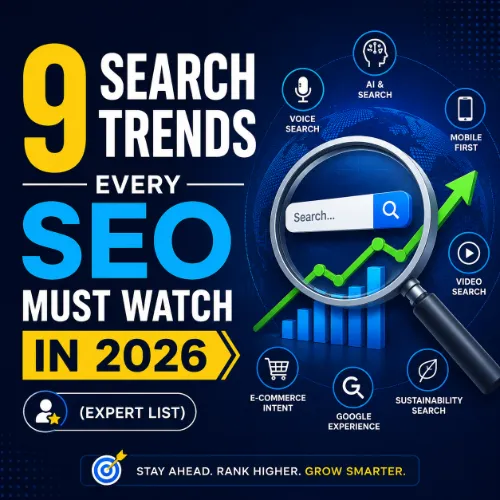
This article outlines nine pivotal search trends every SEO should watch in 2026, from AI Overviews and zero-click searches to brand authority and video-rich results.
Why These search trends every SEO should watch Matter in 2026
Search engines are changing faster than ever. AI-generated overviews now appear above traditional organic results, and users expect instant answers without clicking through. If you ignore these search trends every SEO should watch, your pages risk losing visibility even if they rank well. By monitoring these nine shifts, you can adjust your keyword research, content formats, and technical SEO to stay competitive. For a related guide, see 14 Essential Local SEO Trends for 2026: Strategies to Stay Ahead.
The Shift from Links to Answers
Google’s AI Overviews pull content from multiple sources and present a synthesized answer. This means your content must be concise, authoritative, and structured for extraction. The search trends every SEO should watch emphasize answer-focused writing over keyword stuffing.
User Intent Gets Hyper-Specific
Voice search and conversational queries continue to grow. People ask questions like “How do I fix a leaky faucet?” instead of “plumbing repair.” Aligning your content with natural language patterns is one of the critical search trends every SEO should watch.
1. AI Overviews and the Zero-Click Reality
AI Overviews (formerly Google Bard’s search integration) now answer many queries directly on the SERP. A study by Semrush found that nearly 40% of searches end without a click. For search trends every SEO should watch, this means optimizing for featured snippets and structured data is no longer optional.
Actionable insight: Create dedicated FAQ sections and use schema markup to increase your chances of appearing in AI-generated answers.
2. Brand Authority as a Ranking Signal
Google now weighs brand mentions—even unlinked ones—as a trust signal. Tools like Ahrefs’ Brand Mentions help you track who talks about your business. This is one of the most overlooked search trends every SEO should watch.
Actionable insight: Build relationships with industry publications and encourage unlinked mentions, then convert them into backlinks.
3. People Also Ask (PAA) Expansion
The PAA box now appears on more queries, often pushing the first organic result below the fold. Answering multiple related questions in your content helps you capture these spots. One of the essential search trends every SEO should watch is the growth of PAA as a SERP feature. For a related guide, see 15 AI SEO Tools Worth Trying in 2026: Expert Picks.
Actionable insight: Use tools like AlsoAsked.com to find question clusters, then write a single comprehensive guide that answers them all.
4. Video and Visual Search
YouTube is the second-largest search engine, and Google often surfaces video carousels for “how-to” queries. Short-form video clips are increasingly indexed. For search trends every SEO should watch, adding video transcripts and optimizing video metadata is key.
Actionable insight: Embed a short explainer video on your landing page and submit a video sitemap to Google Search Console.
5. Core Web Vitals: INP Replaces FID
In March 2024, Interaction to Next Paint (INP) replaced First Input Delay. INP measures the time from user interaction to the next visual update. This technical update is a must-know among search trends every SEO should watch.
Actionable insight: Monitor your site’s INP score in PageSpeed Insights, and defer non-critical JavaScript to improve responsiveness.
6. Search Generative Experience (SGE) and Multi-modal Results
Google SGE blends text, images, and videos into a single answer. Your content must be media-rich to qualify for these composite results. Understanding SGE is one of the most forward-looking search trends every SEO should watch.
Actionable insight: Use high-quality images with descriptive alt text and include short video clips that show step-by-step processes.
7. E-E-A-T Becomes a Ranking Gatekeeper
Experience, Expertise, Authoritativeness, and Trustworthiness now influence rankings more than ever. Google’s 2026 update to the Search Quality Rater Guidelines places extra weight on first-hand experience. This is one of the most important search trends every SEO should watch for YMYL (Your Money or Your Life) sites.
Actionable insight: Add author bios, cite primary research, and link to reputable institutional sources.
8. Semantic Search and Entity Understanding
Google now understands topics as entities (people, places, concepts), not just keywords. Your content should connect related entities naturally. Mastering entity SEO is one of the search trends every SEO should watch that separates advanced SEOs from beginners.
Actionable insight: Use schema markup, such as Article and Person, to help Google identify key entities on your page.
9. Local SEO and Hyper-Personalization
Google personalizes results based on location, search history, and device. Local packs now show more business info, including services and reviews. Tracking local search trends is vital for search trends every SEO should watch if you serve a specific geographic area.
Actionable insight: Claim your Google Business Profile, add localized content, and collect recent reviews regularly.
SEO Entities and Their Functions
Understanding key SEO entities helps you apply the search trends every SEO should watch more effectively:
- Organic keywords: Show demand and ranking opportunity. Use keyword research tools to identify question-based queries.
- Backlinks: Dofollow and nofollow links from referring domains build authority. Track new and lost backlinks weekly.
- Featured snippets: These occupy position zero. Optimize by writing clear, direct answers in a list or table format.
- Core Web Vitals: LCP, INP, and CLS impact page experience. Technical audits should flag slow-loading resources.
- Brand mentions: Unlinked mentions from authoritative sites boost E-E-A-T. Use Ahrefs to discover them.
- Local packs: Show Map results for queries with local intent. Optimize your Google Business Profile for inclusion.
Useful Resources
Deepen your knowledge with these credible sources:
- Google SEO Starter Guide – Official best practices from Google.
- Ahrefs SEO Trends Report – Expert insights on evolving search dynamics.
Frequently Asked Questions About search trends every SEO should watch
What are the most important search trends every SEO should watch in 2026?
The top trends include AI Overviews, zero-click searches, brand authority signals, People Also Ask expansion, and Core Web Vitals updates such as INP.
How do AI Overviews affect organic CTR?
AI Overviews often answer queries directly on the SERP, which can reduce organic click-through rates. Optimizing for featured snippets can still capture traffic from the snippet itself.
Why are brand mentions important for SEO?
Google treats brand mentions as trust signals. Unlinked mentions from authoritative sources contribute to E-E-A-T and can improve rankings even without a backlink.
What is INP and why does it matter?
INP (Interaction to Next Paint) measures page responsiveness. It replaced First Input Delay in 2024 and is now a Core Web Vitals metric that impacts rankings.
How can I optimize for People Also Ask?
Use question-based headings, write concise answers in clear paragraphs, and add FAQ schema. Tools like AlsoAsked.com help identify common questions.
What is Search Generative Experience (SGE)?
SGE is Google’s AI-generated answer that blends text, images, and videos. It appears above organic results for complex queries.
Does video content improve SEO rankings?
Yes. Video content increases dwell time and appears in image/video carousels. Adding transcripts and schema markup helps Google index your videos.
How does E-E-A-T affect ranking?
E-E-A-T (Experience, Expertise, Authoritativeness, Trustworthiness) is a ranking factor, especially for health, finance, and legal content. Google evaluates author credentials and content accuracy.
What are entity-based keywords?
Entity-based keywords go beyond words. They represent real-world entities (people, places, concepts) that Google understands semantically, improving contextual relevance.
How do I find brand mentions without a backlink?
Use Ahrefs’ Brand Mentions tool or set up Google Alerts for your brand name. Reach out to authors to request a link when appropriate.
Will zero-click searches continue to rise?
Yes. As AI Overviews expand, more queries will be answered without a click. Focus on capturing featured snippets to maintain visibility.
What is a featured snippet?
A featured snippet is a summary of an answer displayed at the top of Google search results. It is often pulled from a list, table, or paragraph.
How do I get a featured snippet?
Write clear, direct answers to common questions. Use structured formats like numbered lists, tables, or concise paragraphs. Add schema markup where applicable.
What role does user intent play in SEO?
User intent determines whether a searcher wants information, a product, or a specific page. Aligning content with intent improves engagement and rankings.
How can local businesses adapt to 2026 search trends?
Optimize your Google Business Profile, collect reviews, create localized content, and ensure NAP consistency across directories.
What are the best tools to monitor search trends?
Ahrefs, Semrush, Google Trends, and AlsoAsked.com are excellent for tracking keyword shifts and SERP feature changes.
Does social media activity affect SEO?
Social signals are not direct ranking factors, but social shares increase content visibility and can lead to backlinks, which influence rankings.
How often should I update my SEO strategy for these trends?
Review your strategy quarterly. Because search trends evolve rapidly, quarterly audits help you adjust to algorithm updates and new SERP features.
What is the difference between search volume and traffic potential?
Search volume is the number of monthly searches. Traffic potential estimates the actual visits you can get based on CTR and ranking position.
How do I choose the right focus keyword for my article?
Select a keyword with decent search volume, low to medium difficulty, and clear commercial or informational intent. Use keyword research tools for data.