
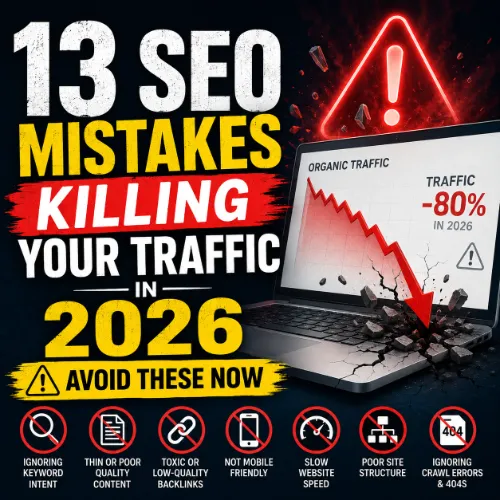
SEO mistakes killing your traffic Key Takeaways
Over the past few years, Google has refined its ranking system to prioritize content that answers intent, loads fast, and comes from trustworthy sources.
- Ignoring AI Overviews and People Also Ask boxes means missing modern SERP opportunities.
- Neglecting Core Web Vitals and mobile usability pushes visitors to competitors.
- Outdated link-building and thin content strategies destroy trust and rankings.
Why These 13 SEO Mistakes Are Killing Your Traffic in 2026
Over the past few years, Google has refined its ranking system to prioritize content that answers intent, loads fast, and comes from trustworthy sources. The same old shortcuts—keyword stuffing, buying links, ignoring technical health—now hurt more than they help. Let’s break down each mistake so you can identify and fix them before your traffic nosedives.
1. Relying on Keyword Stuffing Instead of Semantic Relevance
Using the same phrase ten times on a page used to work. In 2026, Google’s language models understand related terms and intent. If you write only for exact-match keywords, you miss long-tail variants and topical depth. Focus on covering the topic thoroughly rather than repeating the focus keyword.
2. Ignoring Search Intent
Traffic drops when your page doesn’t match what the searcher actually wants. Informational queries need guides or explainers; transactional queries need product comparisons or pricing. Align your content type with the user’s stage in the buying journey.
3. Overlooking Core Web Vitals and Page Experience
Slow loading times, layout shifts, and sluggish interactivity are among the most common SEO mistakes killing your traffic in 2026. Google’s page experience signals directly affect rankings. Run a site audit with tools like PageSpeed Insights and fix Largest Contentful Paint (LCP), First Input Delay (FID), and Cumulative Layout Shift (CLS). For a related guide, see 13 SEO Content Mistakes Beginners Should Avoid (Expert Guide).
4. Neglecting Mobile-First Design
More than 60% of searches happen on mobile. If your site uses desktop-first thinking with pop-ups, tiny fonts, or non-touch-friendly buttons, visitors bounce. Test your pages on real devices and use responsive design.
5. Publishing Thin or Duplicate Content
Short articles that don’t answer the question thoroughly get buried. Duplicate content across your site or syndicated pieces without canonical tags also dilutes authority. Every page must offer unique value—add a table, checklist, or expert insight that competitors don’t have.
6. Building Low-Quality Backlinks
Buying links from spammy directories or participating in link farms used to boost rankings temporarily. Now Google’s link spam updates penalise those tactics. Focus on earning editorial links from real sites through guest posts, original research, and digital PR.
7. Forgetting Internal Linking Strategy
Internal links distribute authority and help users navigate. Many sites either skip internal links or stuff them in footers. Use contextually relevant anchor text within your content to guide readers to deeper resources.
8. Ignoring Technical SEO Fundamentals
Broken links, crawl errors, missing XML sitemaps, and improper redirect chains stop Googlebot from reaching your pages. A quarterly technical audit catches these SEO mistakes killing your traffic. Fix 404s and set up 301 redirects properly.
9. Misusing Structured Data
Schema markup helps search engines understand your content. If you don’t implement it, you miss rich snippets like FAQ, HowTo, and review stars. Even worse, incorrect markup can trigger manual actions. Use Google’s Rich Results Test before deploying.
10. Targeting the Wrong Keywords
Pursuing high-volume terms with extreme keyword difficulty (KD) wastes resources. Pick keywords that match your site’s authority level—target long-tail terms with medium search volume and lower competition first, then work up.
11. Not Optimizing for AI Overviews and SERP Features
Google’s AI Overviews now occupy prime real estate at the top of results. If your content isn’t formatted to be extracted—clear definitions, lists, tables—you lose visibility. Structure your H2s and H3s with questions users actually ask.
12. Posting Inconsistent, Low-Frequency Content
Search engines and audiences both prefer consistency. Publishing once every two months signals a stale site. Commit to a reliable schedule (weekly or bi-weekly) and maintain content freshness by updating older posts with new data.
13. Failing to Track and Adjust Strategy
The biggest SEO mistakes killing your traffic is the belief that SEO is “set and forget.” Rankings shift based on competitor activity, algorithm updates, and user behavior. Monitor your organic traffic via Google Search Console and adjust content and technical tactics quarterly.
SEO Entities and Their Functions
Understanding these entities helps you diagnose why certain SEO mistakes killing your traffic happen and how to fix them.
- Keyword Difficulty (KD): A percentage score (0–100) in tools like Ahrefs that estimates how hard it is to rank for a term. High KD = strong competitor domains already ranking.
- Referring Domains: The number of unique websites linking to your site. More quality referring domains typically correlate with higher rankings.
- Core Web Vitals: Three metrics (LCP, FID, CLS) measuring load performance, interactivity, and visual stability. Poor scores hurt rankings.
- Canonical Tag: An HTML element that tells search engines which URL is the primary version when duplicate content exists. Missing canonicals cause ranking dilution.
- People Also Ask (PAA): A SERP feature showing related questions. Pages that answer these questions can earn featured snippets and more clicks.
How to Fix These Mistakes: A Quick Action Plan
Start with a full site audit to identify which of the 13 mistakes apply to your site. Prioritize technical fixes (CWV, crawl errors) first because they block everything else. Then move to content gaps and keyword realignment. Finally, revamp your link-building strategy to focus on quality over quantity.
Action Steps Summary
| Area | Fix | Tool / Method |
|---|---|---|
| Content | Expand thin pages | Content audit + topical analysis |
| Technical | Improve Core Web Vitals | PageSpeed Insights, GTmetrix |
| Links | Disavow toxic backlinks | Google Search Console, Ahrefs |
| Keywords | Target lower KD terms | Ahrefs Keywords Explorer |
Useful Resources
For deeper dives into each fix, check these authoritative sources:
- Google SEO Starter Guide – Official technical SEO best practices from Google.
- Ahrefs: Common SEO Mistakes and How to Fix Them – Real-world examples and data-driven advice.
Conclusion
Avoiding these 13 SEO mistakes killing your traffic in 2026 requires a shift from old-school hacks to a user-first, data-informed approach. Audit your site regularly, match content to intent, invest in technical health, and build links the right way. Each fix will compound over time, bringing back lost traffic and building sustainable rankings. For a related guide, see 10 Outreach Mistakes That Kill Link Building (Avoid These).
Frequently Asked Questions About SEO mistakes killing your traffic
What is the most common SEO mistake in 2026?
Ignoring search intent and focusing only on keywords without considering what users actually want is still the most widespread mistake.
How do I find SEO mistakes on my site?
Run a site audit using tools like Ahrefs Site Audit or Google Search Console. Look for crawl errors, duplicate content, broken links, and slow page speed.
Can too many backlinks hurt my SEO?
Yes, low-quality or spammy backlinks from link farms can trigger penalties. Focus on acquiring links from authoritative, relevant domains.
How often should I update my content?
Review and refresh pillar pages every 6–12 months. Blog posts with time-sensitive data should be updated as soon as new information becomes available.
What is keyword difficulty and why does it matter?
Keyword difficulty is a metric that estimates how hard it is to rank for a term. High KD means many strong competitors already dominate, making it harder for new pages to break through.
Is mobile-first indexing still important in 2026?
Absolutely. Google uses the mobile version of your site for indexing and ranking. If your mobile experience is poor, your rankings will suffer.
How do I fix duplicate content?
Use 301 redirects to consolidate similar pages, apply canonical tags to the preferred version, and avoid publishing the same content on multiple URLs.
What are Core Web Vitals?
Core Web Vitals are a set of metrics measuring loading performance (LCP), interactivity (FID), and visual stability (CLS). They are a ranking factor in Google’s page experience algorithm.
Should I still use keywords in 2026?
Yes, but with a focus on semantic relevance. Use keywords naturally within comprehensive topic coverage rather than repeating the same phrase.
How do I optimize for AI Overviews?
Structure your content with clear H2 questions, concise definitions, and bullet-point lists. This increases the chance that Google extracts your content for AI summaries.
What is the best way to do internal linking?
Use descriptive anchor text and link from high-authority pages to newer or deeper content. Keep a logical site hierarchy so users and crawlers can navigate easily.
Can social media traffic help my SEO?
Social shares don’t directly influence rankings, but they can increase visibility, drive referral traffic, and lead to more natural backlinks.
How do I perform a site audit?
Use tools like Screaming Frog, Ahrefs Site Audit, or Semrush. Check for issues like broken links, missing meta tags, slow pages, and crawl errors.
Is page speed a ranking factor?
Yes, page speed is a confirmed ranking factor for both desktop and mobile. Slow pages increase bounce rates and lower user satisfaction.
What are SERP features?
SERP features are special search result elements like featured snippets, People Also Ask boxes, and local packs that appear outside the standard organic results.
How do I recover from a Google penalty?
Identify the penalty type (algorithmic vs. manual). Fix the underlying issue—remove bad links, improve thin content, or resolve technical violations—then submit a reconsideration request if needed.
Should I use exact-match anchor text?
Use a mix of branded, generic, and partial-match anchor text. Overusing exact-match anchors looks unnatural and can trigger spam filters.
What is the difference between dofollow and nofollow links?
Dofollow links pass link equity and authority. Nofollow links do not. Both are natural parts of a healthy backlink profile, but dofollow links are more valuable for rankings.
How do I track my SEO progress?
Monitor organic traffic, keyword positions, and backlink growth using Google Search Console and tools like Ahrefs. Set up monthly reports to spot trends.
Can I rank without backlinks?
For very low-competition keywords, it’s possible. But for most commercial and informational queries, backlinks are essential for demonstrating authority.