zero click SEO strategies Key Takeaways
As search engines increasingly answer queries directly on the results page, relying solely on traditional click-through traffic is no longer enough.
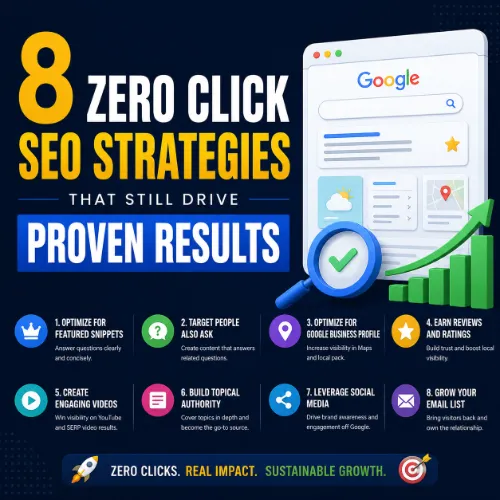
- Zero-click SEO strategies focus on owning SERP features like featured snippets and knowledge panels.
- Structured data, concise Q and A formatting, and local optimization are core to winning zero-click real estate.
- Measuring branded search lift and impression share matters more than click-through rate for zero-click success.
Featured snippets are the most visible zero-click asset. They appear at the very top of mobile and desktop results, often in a paragraph, list, or table format. To earn one, structure your content as direct answers to specific questions.
Implementation Tip
Identify query-based keywords with question words (how, what, why). Write a concise, 40-60 word answer at the start of your relevant section. Use paragraph schema and a clear <h2> or <h3> right before the answer. For list-style snippets, use bullet or numbered lists.
Strategy 2: Own the People Also Ask Box
People Also Ask (PAA) boxes appear for most informational queries. Each PAA question expands into a mini-answer, often pulled from a single page. If your content answers multiple related questions within one article, you can occupy several PAA slots.
Real-World Example
A travel blog covering “packing tips for Europe” might answer “What size luggage is allowed?” “Do I need a power adapter?” and “Can I bring toiletries on a plane?” within the same post. Each subheading with a short paragraph answer went into a PAA box, generating thousands of extra impressions monthly.
Strategy 3: Structure Data for Rich Results
Rich results — star ratings, product prices, recipe timers, event dates — are zero-click features that still drive interaction without a page visit. Google uses structured data (schema markup) to display these elements. Even if the user doesn’t click, they see your brand and offering.
Action Steps
Add FAQ schema, HowTo schema, or Product schema to relevant pages. Use Google’s Rich Results Test to validate markup. The goal is to make your page eligible for every possible rich result in your niche.
Strategy 4: Target Local Packs for Zero-Click Local Visibility
Local packs — the map + three listings that appear for local queries — are a classic zero-click feature. Users often see your business name, address, phone number, hours, and reviews without clicking to your site. Yet, that exposure drives calls, store visits, and brand recall.
Local Optimization Tactics
Ensure your Google Business Profile is fully verified and optimized with accurate NAP, categories, photos, and updated hours. Encourage authentic customer reviews and respond to them promptly. For local queries like “coffee shop near me,” being in the local pack is your zero-click SEO win.
Strategy 5: Create Definitive How-To Guides with Lists
Google’s algorithm increasingly favors step-by-step content for how-to queries. A well-structured list with <ol> and clear instructions can be pulled directly into a list-style snippet or AI Overview. This positions your brand as the expert source even if no click occurs.
Success Signal
One cooking site saw a 40% increase in impressions for “how to dice an onion” after restructuring its guide as a numbered list with timestamps and short paragraphs. The snippet appeared first on mobile for weeks.
Strategy 6: Use AI Overviews as a Content Target
AI Overviews (formerly SGE) generate a paragraph-length answer from multiple sources. Pages that are cited in AI Overviews often get zero clicks from that specific result, but they earn authoritative brand visibility, trust signals, and potential backlinks from journalists covering the topic.
Optimization Approach
Publish high-authority content on topics where your brand can be the primary source. Use clear, factual language, cite external credible sources, and structure your article with short paragraphs and bolded key phrases. The goal is to become the page Google trusts to summarize an answer.
Strategy 7: Build a Knowledge Panel Through Wikipedia and Wikidata
A knowledge panel is the ultimate zero-click asset — it’s your brand’s entire identity presented in the SERP. While difficult for small sites, any notable brand can increase its chances by having a Wikipedia article (or at least a Wikidata entry) that is well-sourced and neutral.
Practical Tip
For local businesses or niche brands, start with a Wikidata entry with correct claims (founded date, location, industry). Next, get listed on high-authority sites like Crunchbase, AngelList, or industry-specific directories. Google cross-references these signals to build knowledge panels.
Strategy 8: Measure What Matters — Branded Search Lift
Zero-click visibility often doesn’t show in your click-through analytics. Instead, measure branded search lift — the increase in searches for your brand name after appearing in a zero-click feature. Use Google Search Console to track branded query impressions and compare them before and after your optimizations.
Example Metric
A software company saw a 60% increase in branded impressions for “AcmeCRM” after winning three featured snippets and a knowledge panel. Those impressions led to direct navigational searches, which have high conversion rates.
SEO Entities and Their Functions
To execute the zero-click SEO strategies above effectively, you need to understand the entities that power SERP feature analysis.
- Website / Domain entities: Root domain, subdomain, and URL-level analysis show whether a zero-click win is coming from a top-level domain or a specific section of your site.
- Keyword entities: Organic keywords, search volume, keyword difficulty (KD), and SERP features indicate demand, competition, and which features trigger for a query.
- SERP entities: Featured snippets, People Also Ask, AI Overviews, local packs, and sitelinks reveal the exact format you need to match.
- Backlink entities: Referring domains and dofollow/nofollow distribution help you evaluate if a page has the authority to appear in zero-click features.
- Content entities: Articles, authors, topics, and publication dates help Google determine freshness and topical relevance.
- Technical SEO entities: Core Web Vitals, crawl issues, and indexability ensure your pages are eligible to be shown in the first place.
- Competitor entities: Shared keywords, content gap opportunities, and competing pages show where your competitors win zero-click visibility that you can capture.
Useful Resources
For deeper dives into structured data testing, visit Google’s Rich Results Test tool. To monitor your branded search lift, check Google Search Console’s performance report at search.google.com/search-console.
Implementing these zero-click SEO strategies doesn’t require a complete overhaul of your current approach — it simply asks you to think beyond the click. Start by picking one strategy from this list: optimize a single page for a featured snippet, or update your Google Business Profile. Test it for 30 days, monitor your branded search lift, and then expand to the next tactic. The visibility you build today becomes the traffic you earn tomorrow.
Frequently Asked Questions About zero click SEO strategies
What is zero-click SEO ?
Zero-click SEO refers to strategies that optimize content to appear in search engine result page features — like featured snippets, People Also Ask boxes, knowledge panels, and local packs — where users get their answer without clicking through to a website. It focuses on visibility and brand exposure rather than direct traffic. For a related guide, see 15 GEO Strategies to Rank in ChatGPT and Gemini (Proven).
How do featured snippets work for zero-click SEO ?
Featured snippets pull a concise answer from a webpage and display it at the top of the search results. To optimize, structure your content as a direct answer to a specific question, using clear headings and short paragraphs. Google selects the answer from well-structured, authoritative pages.
Is zero-click SEO worth it if users don’t click?
Yes. Zero-click visibility builds brand authority, drives branded search traffic, and can lead to indirect conversions such as phone calls, store visits, or later direct searches. It also positions you as an expert in your industry, which can attract backlinks and social shares. For a related guide, see 15 Proven Link Building Strategies Still Working in 2026.
What is the difference between zero-click SEO and traditional SEO?
Traditional SEO focuses on ranking organically to earn clicks from the SERP. Zero-click SEO aims to be visible within SERP features themselves, even if no click occurs. Both strategies should work together, but zero-click SEO prioritizes visibility and brand presence over direct traffic metrics.
How do I find zero-click keywords for my industry?
Use keyword research tools to identify question-based queries and analyze SERP features. Look for keywords that already trigger featured snippets, People Also Ask boxes, or local packs. You can also search manually by typing query words into Google and noting which features appear.
What role does schema markup play in zero-click SEO ?
Schema markup (structured data) tells Google exactly what your content means — whether it is a FAQ, a how-to guide, a recipe, or an event. This markup increases your chances of appearing in rich results and knowledge panels, which are zero-click features.
Can zero-click SEO work for local businesses?
Absolutely. Local packs, Google Business Profile listings, and Google Maps results are powerful zero-click features. Optimizing your GBP with accurate NAP, hours, photos, and reviews can make your business visible to local searchers without requiring a website click.
Do AI Overviews affect zero-click SEO strategies ?
Yes, AI Overviews are a major zero-click feature. They generate summary answers from multiple sources. To be cited, publish high-authority, factual content that Google trusts. Your brand gains visibility even if the AI Overview doesn’t link to you.
How do I measure the success of zero-click SEO ?
Track branded search impression lift in Google Search Console, monitor visibility for featured snippet and local pack positions using rank trackers, and analyze brand mentions or social shares that increase after a zero-click win. Direct traffic metrics alone won’t capture zero-click value.
What are the most common zero-click SERP features?
The most common features include featured snippets, People Also Ask boxes, local packs, knowledge panels, image packs, video results, top stories, and AI Overviews. Each rewards a specific content format — short answers, lists, maps, or rich media.
Does zero-click SEO work for B2B companies?
Yes, especially through featured snippets, People Also Ask, and knowledge panels. B2B companies can win visibility for industry-specific queries like “what is ERP software” or “benefits of cloud computing.” Snippets in these searches build credibility with decision-makers.
How often should I update content for zero-click SEO ?
Review and refresh every 6 to 12 months. Zero-click features can change as Google updates its algorithms. Ensure your answers remain accurate, your schema stays valid, and your facts are current. Freshness signals also help maintain snippet presence.
Can I target multiple zero-click features with one page?
Yes, one page can appear in multiple features. For example, a how-to guide with a step-by-step list might win a featured snippet, a People Also Ask slot, and a video result if you include a short tutorial video. Structure your page to answer several related questions.
What is the role of backlinks in zero-click SEO ?
Backlinks remain important because Google uses them as a relevancy and authority signal. Pages with strong backlink profiles are more likely to be selected for featured snippets and knowledge panels. Focus on earning links from authoritative, thematically relevant sites.
How do I avoid losing traffic to zero-click features?
Instead of avoiding zero-click features, embrace them as a visibility tool. Complement your zero-click strategy with compelling meta descriptions, internal links that guide users deeper into your site, and clear calls to action within your content. The visibility often pays off even without a direct click.
Does Google penalize sites that try to game zero-click features?
No, but Google does reward genuine, high-quality content. If you stuff your page with unrelated keywords or try to manipulate structured data, you risk a manual action or algorithmic demotion. Always optimize for a better user experience first.
What is the best content format for zero-click SEO ?
Short, direct answers (40-60 words) under clear headings are best for featured snippets. Lists with bullets or numbers work well for list-style snippets. How-to guides with steps and timestamps also perform well. Always match the format to the query intent.
Can zero-click SEO increase my overall organic traffic?
Yes, indirectly. Appearing in zero-click features boosts your brand’s credibility and recall. Users who see your name repeatedly in snippets are more likely to conduct a branded search later, which usually leads to a click and conversion. It builds a virtuous cycle of visibility and trust.
How do I compete with big brands for zero-click features?
Focus on niche long-tail keywords with low competition. Create definitive, authoritative content for specific topics. Use unique data, original research, or expert quotes to differentiate your page. Smaller sites can still win snippets by being the most accurate and helpful.
What should I do if my featured snippet disappears?
First, check if Google changed the query’s SERP feature (e.g., swapped a paragraph snippet for a list snippet). Then review your content’s freshness and accuracy. Update the target section, add more specific data or examples, and revalidate your structured data. Often, a simple refresh can regain the spot.