
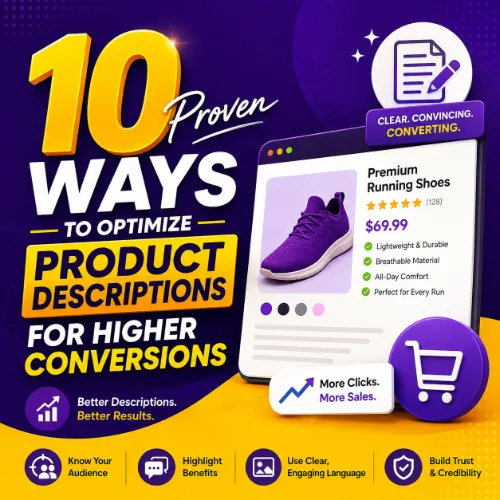
optimize product descriptions Key Takeaways
In a crowded online marketplace, your product description often makes the difference between a sale and a bounce.
- Use sensory words and benefit-driven language to trigger emotional buying responses.
- Incorporate long-tail keywords naturally to capture ready-to-buy traffic.
- Leverage social proof and scannable formatting to reduce friction and build trust.
Why You Need to Optimize Product Descriptions for Conversions
In a crowded online marketplace, your product description often makes the difference between a sale and a bounce. Shoppers can’t touch or try your product, so your words must bridge that gap. When you optimize product descriptions for both search engines and human psychology, you create a frictionless path to purchase. The best part? Small tweaks in wording, structure, and keyword placement can yield measurable lifts in conversion rates. Below, we break down ten proven tactics you can implement today. For a related guide, see 10 Product Page SEO Optimizations to Avoid Costly Mistakes.
1. Start With Customer-Centric Benefits, Not Just Features
Features tell, but benefits sell. Instead of listing technical specs, translate each feature into a clear benefit for the shopper. For example, “10-hour battery life” becomes “Work all day without hunting for an outlet.” This approach aligns with the way buyers actually decide. When you improve product descriptions for conversions, always lead with the “what’s in it for me” angle.
How to Shift From Features to Benefits
- List every feature of your product.
- Ask yourself: “Why does this matter to the customer?”
- Write the answer as a benefit statement.
- Combine feature + benefit in one sentence when possible.
2. Use Sensory and Emotional Language
Words that appeal to the senses — touch, taste, sight, sound, smell — make abstract products feel tangible. Instead of “soft fabric,” say “buttery-soft cotton that feels like a gentle hug.” Emotional triggers like “confidence,” “peace of mind,” and “joy” also resonate deeply. These techniques help you optimize product descriptions for emotional connection, which drives impulse buys.
3. Naturally Incorporate Long-Tail Keywords
Long-tail keywords like “ergonomic office chair for lower back pain” attract shoppers with high purchase intent. Use a tool like Ahrefs or Google Keyword Planner to find relevant phrases, then weave them into your headings, bullet points, and body text. Remember: never stuff keywords. A natural flow keeps readers engaged and helps your product description tips rank higher in search results.
Long-Tail Keyword Placement Checklist
- Include the primary long-tail keyword in the first 100 words.
- Use variations in H2 and H3 headings where relevant.
- Add one or two in bullet points or product specifications.
- Avoid repeating the same exact phrase more than 2-3 times.
4. Write Scannable, Skimmable Copy
Online readers scan before they read. Break your description into short paragraphs (2-4 sentences max), use bullet points for key features, and highlight important words with bold text. A clean, scannable layout reduces cognitive load and makes it easy for shoppers to find what they care about most. This is a core part of any strategy to optimize product descriptions for usability.
5. Include Social Proof and Trust Signals
Testimonials, star ratings, and usage statistics (e.g., “9 out of 10 users noticed results in 2 weeks”) reduce perceived risk. Embed a short quote from a verified buyer or mention the number of units sold. Trust signals like “30-day money-back guarantee” or “free shipping” also relieve buyer anxiety. When you improve product descriptions for conversions, leverage the power of social validation.
6. Use a Clear and Compelling Call-to-Action
A vague “Learn More” button won’t cut it. Use action-oriented CTAs that match the buyer’s stage: “Add to Cart — Free Shipping,” “Get Yours Before They Sell Out,” or “Start Your Risk-Free Trial.” Place the primary CTA near the top and again after the description. An effective CTA is a direct way to optimize product descriptions for clicks and conversions.
7. Tell a Mini-Story Around the Product
Storytelling creates a memorable emotional hook. Describe how the product solves a specific problem or came to be created. For instance, “After struggling to find a durable, eco-friendly water bottle, we designed one that could survive a drop off a cliff — and a decade of daily use.” Stories make the description unique and shareable, enhancing your product description tips with narrative depth.
8. Add a Comparison Table (When Relevant)
If you sell multiple variations or models, a simple comparison table helps shoppers decide quickly. Include columns for price, size, key features, and the ideal use case. Tables reduce uncertainty and prevent decision paralysis. Use this alongside narrative copy to optimize product descriptions for both logical and emotional buyers.
| Feature | Basic Model | Premium Model |
|---|---|---|
| Battery Life | 6 hours | 12 hours |
| Warranty | 1 year | 3 years |
| Weight | 1.2 lbs | 0.8 lbs |
| Ideal For | Casual use | Daily commuters |
9. Optimize for Mobile Readability
Over half of ecommerce traffic comes from mobile devices. Use short sentences, larger font sizes (implied via spacing), and tap-friendly CTA buttons. Avoid long walls of text that require zooming. A mobile-optimized description directly impacts user experience and conversion rates. This is a non-negotiable part of any strategy to optimize product descriptions in 2025. For a related guide, see 11 Proven Ways to Boost eCommerce CTR Instantly.
10. Continuously A/B Test and Update
Your first draft won’t be your best. Run A/B tests on different headlines, CTAs, and description lengths. Monitor which versions drive more add-to-carts and revenue. Use heatmaps and session recordings to spot where users drop off. Treat each product description as a living asset that you refine over time. Consistent testing is the ultimate way to improve product descriptions for conversions.
Putting It All Together: A Quick Example
Let’s compare a weak description with an optimized one for a bamboo cutting board:
Before: “Bamboo cutting board. 12×18 inches. Durable.”
After: “Slice, chop, and dice with confidence on our organically grown bamboo cutting board. Naturally antimicrobial, it resists bacteria better than plastic. The 12×18 surface gives you room to prep a full meal — and it looks beautiful on your counter. Join 5,000+ happy home chefs.”
The second version includes a benefit, sensory language, social proof, and a clear value proposition. That’s how you optimize product descriptions for real results.
Useful Resources
Explore these authoritative sources to deepen your understanding of ecommerce copywriting and conversion optimization:
- Neil Patel: How to Write Product Descriptions That Sell — Step-by-step guide with real examples.
- Ahrefs: Ecommerce SEO Guide — Comprehensive strategy for ranking product pages.
Frequently Asked Questions About optimize product descriptions
What does it mean to optimize product descriptions ?
Optimizing product descriptions means refining the copy, structure, and keywords to improve search engine visibility, user engagement, and conversion rates. It combines SEO best practices with persuasive writing.
How long should a product description be?
There is no perfect length, but 150–300 words is a good target for most products. Longer descriptions work well for complex items (e.g., electronics), while short descriptions suit simple, low-consideration products.
Can I use the same description for multiple products?
No. Duplicate content can harm your SEO and confuse shoppers. Each product page should have a unique description that highlights its specific features and benefits.
What is the best keyword density for product descriptions?
There is no magic number, but aim for natural readability. Keyword density of 1–2% is typical. Focus on including keywords where they fit organically, not on hitting a specific percentage.
Should I include pricing in the description?
Usually, pricing is displayed separately, but you can mention value comparisons (e.g., “Save 20% vs. similar models”). Avoid repeating the price if it’s already prominent on the page.
How do I write descriptions for technical products?
Translate specs into real-world benefits. For example, instead of “4GB RAM,” say “Seamlessly switch between apps with 4GB of memory.” Use a spec table for details and keep the narrative benefit-focused.
What role do bullet points play in product descriptions?
Bullet points make key features scannable. They help shoppers quickly find what they need, especially on mobile. Always lead with the most compelling benefit in the first bullet.
How often should I update product descriptions?
Review descriptions every 3–6 months. Update them when you launch new product variants, receive new customer feedback, or notice a dip in conversions. Regular updates also signal freshness to search engines.
Can I use emojis in product descriptions?
Yes, sparingly. Emojis can add personality and draw attention to key points, especially on social media or mobile-friendly sites. Don’t overdo it; one or two per description is enough.
What is the best way to handle out-of-stock descriptions?
If a product is temporarily out of stock, update the description to include an estimated restock date and a “Notify Me” option. Remove or archive the page for permanently discontinued items to avoid confusing shoppers.
Should I write descriptions in first person or third person?
Third person is standard and feels more professional. However, first person can work for brands with a distinct voice (e.g., “We designed this for adventurers”). Choose what fits your brand identity.
How do I optimize product descriptions for voice search?
Use natural, conversational language and question-based phrases. For example, “What makes this blender quiet?” Answers that match spoken queries can help you appear in voice search results.
What is the biggest mistake in product description writing?
Writing only features without benefits. Shoppers want to know how the product will improve their life. Another common mistake is ignoring SEO entirely — missing out on organic traffic.
How do I find the right keywords for a product?
Use keyword research tools like Ahrefs, Google Keyword Planner, or SEMrush. Look for long-tail keywords with decent search volume and low keyword difficulty. Also check competitors’ pages for ideas.
Should I use customer reviews in the description?
Absolutely. Pull direct quotes from positive reviews and add them as social proof. For example, “One customer said: ‘This bag replaced my suitcase for weekend trips.’”
How can I make product descriptions more persuasive?
Use power words (e.g., “exclusive,” “instant,” “guaranteed”), tell a mini-story, include scarcity triggers (e.g., “only 5 left”), and address common objections before the shopper thinks of them.
What is the ideal reading level for product copy?
Aim for a 6th to 8th grade reading level. That doesn’t mean dumbing it down — it means using simple, clear language that anyone can understand quickly. Test your copy with a readability tool.
How do I optimize descriptions for Pinterest and social sharing?
Include a short, shareable sentence that summarizes the product’s wow factor. Add relevant hashtags in the description if the platform allows. High-quality images with overlaid text also help.
Can I automate product description writing?
AI tools can generate drafts, but always edit for brand voice, accuracy, and persuasiveness. Automated descriptions often lack the emotional nuance that drives conversions. Use them as a starting point, not a final version.
What is the most important thing to remember?
Your customer is the hero. Every sentence should help them solve a problem or feel good about their purchase. When you focus on serving the reader, both SEO and conversions follow naturally.