
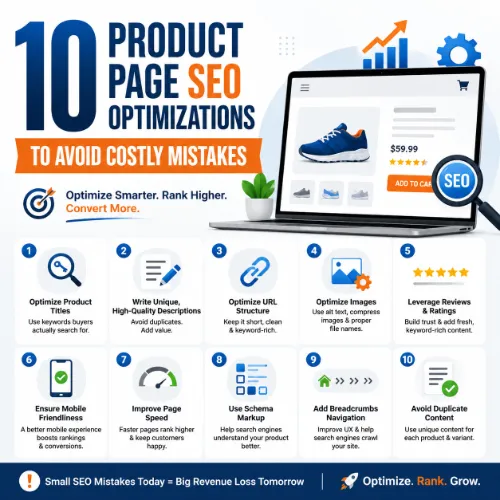
product page SEO optimizations Key Takeaways
Search engines today reward pages that provide clear, specific, and trustworthy information.
- Core product page SEO optimizations include title tags, unique descriptions, structured data, image optimization, and review markup.
- Each optimization addresses a specific ranking factor or user behavior signal that search engines measure.
- Common mistakes like duplicate content, missing alt text, and broken internal links can undo your SEO work overnight.
Why Product Page SEO Optimizations Matter More Than Ever
Search engines today reward pages that provide clear, specific, and trustworthy information. Product pages are unique because they combine transactional intent (the shopper wants to buy) with informational needs (the shopper needs to know exactly what they are buying). If your page fails to answer both, it will underperform. The product page SEO optimizations in this article target every layer of the search experience—from crawling and indexing to click-through rate and conversions. Ignoring any one of these can lead to lost rankings, wasted ad spend, and frustrated customers. For a related guide, see 11 AI SEO Experiments: Smart Ways to Boost Your Rankings.
1. Write Unique, Keyword-Rich Title Tags and Meta Descriptions
Every product page must have a unique title tag and meta description. The title tag should include the product name, a key benefit, and the focus keyword naturally. For example, “Men’s Waterproof Hiking Boots – Durable Grip for All Trails” is better than just “Hiking Boots.” The meta description should expand on the promise, include a secondary keyword, and add a clear call to action like “Shop now for free shipping.”
Common Mistake to Avoid
Do not use the same title and description for multiple products, even if they are similar. Each variation should feel distinct to avoid duplicate content penalties.
2. Optimize Product Images with Alt Text and File Names
Images often account for most of a product page’s weight. Product page SEO optimizations for images include renaming the file from “IMG_4571.jpg” to “mens-waterproof-hiking-boots-black.jpg” and writing descriptive alt text that includes the target keyword where natural. Alt text helps visually impaired users, improves image search rankings, and provides additional context for the page’s topic.
Implementation Tip
Keep alt text under 125 characters, describe exactly what the image shows, and avoid keyword stuffing. Use multiple images and assign alt text to each one.
3. Add Structured Data (Schema Markup) for Rich Results
Structured data helps search engines understand your product details: price, availability, reviews, and brand. Implementing Product schema can trigger rich snippets in search results, including star ratings, price ranges, and stock status. These rich results increase click-through rates significantly. You can test your markup using Google’s Rich Results Test. For a related guide, see 7 AI SEO Predictions for the Next 5 Years: Expert Forecasts to Avoid Costly Mistakes.
Key Schema Properties to Include
- Product name, description, and image URL
- Offer details: price, currency, availability
- AggregateRating and Review markup if you have user reviews
- Brand, SKU, and GTIN where applicable
4. Create Descriptive, Unique Product Descriptions
Do not rely solely on manufacturer descriptions. Search engines and users alike value original content that explains the product’s features, materials, usage, and benefits. Longer, unique descriptions that answer real buyer questions tend to rank higher. For each product, write at least 150–300 words that include your focus keyword and related terms naturally.
How to Approach This at Scale
Start with your top 20–30 revenue-generating products. Write custom descriptions for those. For lower-volume items, use templates with variable fields that still feel personal and useful.
5. Improve Page Load Speed and Core Web Vitals
Page speed is a direct ranking factor and a major user experience signal. Compress images, use a content delivery network (CDN), remove unused CSS and JavaScript, and enable lazy loading. The three Core Web Vitals metrics—Largest Contentful Paint (LCP), First Input Delay (FID), and Cumulative Layout Shift (CLS)—are critical for product pages because they affect how quickly and smoothly a visitor can see and interact with the product.
6. Use Customer Reviews and User-Generated Content
Reviews add fresh, unique content to a product page, which search engines love. They also introduce long-tail keywords that real customers use. Encourage reviews by sending follow-up emails, offering small incentives, and making the submission process simple. Display reviews with structured data to qualify for review stars in search results.
Beyond Reviews
Consider including a Q and A section where customers can ask and answer product questions. This adds even more unique text and helps with SEO.
7. Optimize Internal Linking and Breadcrumbs
Internal links help search engines discover all your product pages and pass authority between them. Use breadcrumb navigation so users and search engines understand the site hierarchy: Home > Category > Subcategory > Product. Link from product pages to related products, category pages, and relevant blog content. This signals topical relevance and improves crawl efficiency.
8. Ensure Mobile-Friendliness and Responsive Design
Most ecommerce traffic now comes from mobile devices. A product page that is not fully responsive will lose rankings and conversions. Test your page on multiple screen sizes, ensure buttons are large enough to tap, text is readable without zooming, and images resize properly. Google uses mobile-first indexing, meaning it uses the mobile version of your page to determine rankings.
9. Include Clear Calls to Action and Trust Signals
While not a direct ranking factor, user engagement signals (time on page, bounce rate, conversions) influence SEO indirectly. A well-designed product page with clear calls to action (“Add to Cart,” “Buy Now”), trust badges (secure checkout, money-back guarantee), clear return policies, and visible contact information keeps users engaged. Lower bounce rates and higher dwell time send positive signals to search engines.
10. Monitor and Fix Technical Issues Regularly
Technical product page SEO optimizations include checking for broken links, fixing 404 errors, ensuring canonical tags are correct, and verifying that all product pages are indexable. Use a site audit tool to scan for duplicate content, missing meta tags, and slow pages. Fixing these issues prevents search engines from penalizing your site and ensures your optimization efforts are not wasted.
Implementation Tip
Set up a monthly audit schedule. Automate as much as possible using tools like Google Search Console and crawling software.
SEO Entities and Their Functions
Understanding key SEO entities helps you make informed decisions about your product pages. Here is how they relate:
- Root domain and subdomain analysis — Determine whether your ecommerce site’s authority sits at the domain level (example.com) or needs separate tracking for sections like blog.example.com.
- Organic keywords and keyword difficulty — For each product page, check search volume and competition to identify which keywords are realistically attainable.
- Backlinks (referring domains, anchor text) — Links from reputable product reviews, blogs, or resource pages boost product page authority. Monitor new and lost backlinks regularly.
- Page entities (top pages by traffic, top pages by links) — Identify which product pages already perform well and replicate their structure or content strategy for lower-ranking pages.
- Core Web Vitals and crawl issues — Technical metrics like LCP, CLS, and indexability issues directly impact user experience and ranking eligibility.
- SERP features (featured snippets, People Also Ask, product carousels) — Structure your product descriptions and Q and A sections to appear in these rich results for higher visibility.
Useful Resources
For further reading on implementing product page schema, visit Google’s Product Structured Data Documentation. To test your Core Web Vitals and page speed, use the PageSpeed Insights Tool.
Frequently Asked Questions About product page SEO optimizations
What is the most important product page SEO optimization?
While all ten optimizations matter, writing a unique, keyword-rich title tag and meta description is the most impactful starting point because it directly affects click-through rate from search results.
How long should a product description be for SEO?
Aim for at least 150–300 words of unique, helpful content that describes features, benefits, materials, and usage. Longer descriptions that answer real buyer questions tend to rank better.
Does duplicate content hurt product page SEO ?
Yes. Duplicate content from manufacturer descriptions or identical product variations can cause search engines to devalue your pages. Write original descriptions or use canonical tags to indicate the primary version.
How do I get product reviews for my ecommerce site?
Send follow-up emails after purchase, offer a small discount or loyalty points for submitting a review, and make the review process simple and visible on the product page.
Is page speed still a ranking factor for product pages?
Yes, page speed and Core Web Vitals are confirmed ranking factors. Faster product pages reduce bounce rates and improve user experience, which indirectly helps SEO.
What is structured data for product pages?
Structured data (schema markup) is code added to a page that helps search engines understand product details like price, availability, and reviews. It can create rich snippets in search results.
How many images should a product page have?
Use at least 3–5 high-quality images from different angles. Include a zoom feature and lifestyle shots if possible. Each image should have unique, descriptive alt text.
Should I use the same alt text for every product image?
No. Each image should have unique alt text that describes what the image shows. Duplicate alt text can look spammy and reduces the SEO benefit.
What are breadcrumbs in SEO?
Breadcrumbs are a navigation trail showing the user’s path from the homepage to the current page. They improve usability and help search engines understand site structure. Use breadcrumb schema for enhanced display.
How do I fix broken links on product pages?
Use a site audit tool or Google Search Console to identify broken links. Either update the link to a working page or remove it. Set up 301 redirects for permanently moved product pages.
Does mobile-friendliness affect product page rankings?
Yes, Google uses mobile-first indexing, so the mobile version of your product page determines rankings. A non-responsive page will lose visibility on all devices.
What is the ideal title tag length for product pages?
Keep title tags between 50–60 characters including spaces. This ensures the full title displays in search results without being cut off.
Can I use the same schema markup for all products?
You can use the same schema type (Product) but each property like name, price, and description must be unique per product. Do not copy-paste the same markup.
How often should I update product page content?
Update product pages when specifications change, new versions launch, or you add new user reviews. Avoid rewriting just for freshness, but keep content accurate.
Do out-of-stock product pages hurt SEO?
Permanently out-of-stock pages should either be removed or redirected. Temporarily out-of-stock pages can remain with a note and the option to be notified when back in stock.
What is the difference between internal linking and breadcrumbs?
Internal links are clickable links between pages on your site. Breadcrumbs are a specific type of internal navigation that shows the site hierarchy. Both help SEO.
Should I use nofollow on product page links?
Use nofollow only for sponsored or user-generated links. Regular internal links and links to authoritative product reviews should be follow links to pass authority.
How do I find the best keywords for a product page?
Use keyword research tools like Ahrefs or Google Keyword Planner to find terms with good search volume and low to medium competition. Include product-specific terms like brand, model, color, and use case.
Can social sharing help product page SEO ?
Social shares themselves are not a direct ranking factor, but they can drive traffic, increase visibility, and lead to natural backlinks, which do help SEO.
Do I need a separate URL for each product variation?
It depends. If variations (size, color) have significantly different content or user intent, separate URLs with unique descriptions can work better. Otherwise, use a single URL with parameters or variant selection.