
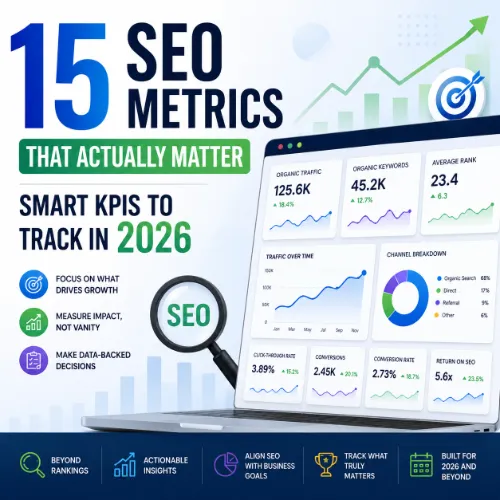
SEO metrics that actually matter Key Takeaways
Organic traffic is the number of visitors who land on your site from unpaid search results.
- SEO metrics that actually matter include organic traffic, keyword rankings for high-intent terms, click-through rate from search, and conversion rate — not just page views.
- Bounce rate alone can mislead; pair it with average session duration and pages per session to understand true engagement.
- Technical metrics like Core Web Vitals, crawl errors, and index status directly affect your visibility in search results.
Why Most SEO Dashboards Fail — and How to Fix Yours
Many marketers drown in data. They track thousands of keywords, monitor every fluctuation in rankings, and celebrate when traffic spikes — only to realize revenue didn’t budge. That’s because they’re watching important SEO metrics that look good on a report but don’t drive business outcomes. The fix is simple: shift your focus to SEO metrics that actually matter — indicators that correlate with real user satisfaction, search engine trust, and conversion. For a related guide, see 7 Proven Ways to Track SEO ROI (Avoid These Costly Mistakes).
This article cuts through the noise. You’ll learn exactly which 15 key SEO performance indicators to put on your dashboard, how to interpret them, and what actions to take when they signal trouble.
1. Organic Traffic (the Baseline Metric)
Organic traffic is the number of visitors who land on your site from unpaid search results. It’s the most straightforward metric, but only when segmented by landing page, device, and geography. Without this baseline, you can’t measure growth. Track it in Google Search Console or your analytics tool, and compare month-over-month to spot trends.
2. Keyword Rankings (High-Intent Terms Only)
Ranking for thousands of generic keywords feels good, but it rarely pays the bills. Focus on SEO metrics that matter like rankings for terms with commercial or informational intent relevant to your product or service. Use a rank-tracking tool to monitor your top 50–100 priority keywords weekly.
3. Click-Through Rate (CTR) from Search
CTR measures the percentage of searchers who click your listing after seeing it on a SERP. A high CTR tells Google your title and meta description match what people want. A low CTR — even with good rankings — means you need better snippets. Test headline formulas, add power words, and include your focus keyword naturally.
4. Conversion Rate (the Metric That Pays)
Traffic means nothing if it doesn’t convert. Whether your goal is a purchase, a sign-up, or a phone call, conversion rate is the ultimate key SEO performance indicator. Set up goals in Google Analytics and trace conversions back to specific organic landing pages. Pages with high traffic but low conversion need stronger calls to action or better user experience.
5. Bounce Rate (with Context)
Bounce rate alone can mislead. A blog post that answers a quick question may have a high bounce rate yet perfectly satisfy the user. Pair it with metrics that matter like average time on page and pages per session. If those numbers are low too, your content may not match the search intent.
6. Pages per Session
Pages per session measures how deep users engage with your site. A steady or rising number indicates your internal linking and content quality encourage exploration. Use this metric alongside organic traffic to confirm that growth comes from engaged visitors, not accidental clicks.
7. Average Time on Page
This metric reveals whether readers actually consume your content. For informational queries, a longer time on page signals thoroughness. For transactional pages, it may indicate hesitation — which can be improved with clearer CTAs or faster load times. Both are important SEO metrics for content audits.
8. Core Web Vitals (LCP, FID, CLS)
Google’s page experience signals — Largest Contentful Paint, First Input Delay, and Cumulative Layout Shift — directly impact rankings, especially in competitive niches. Run a free Lighthouse report monthly. Aim for LCP under 2.5 seconds, FID under 100 ms, and CLS under 0.1.
9. Crawl Errors and Index Status
If Googlebot can’t crawl your pages, they can’t rank. Monitor crawl errors in Google Search Console: 404s, server errors, and blocked resources. Also check your index status — the number of pages Google has indexed. A sudden drop often signals a technical issue.
10. Backlink Growth (Referring Domains)
Not all links are equal, but the number of unique referring domains is a healthy key SEO performance indicator. A steady increase shows your content earns trust. Use a backlink tool like Ahrefs or Semrush to track new and lost domains each month. If domains drop, investigate lost opportunities.
11. Page Load Speed (Mobile and Desktop)
Speed affects both user experience and rankings. Test your site with Google PageSpeed Insights. Mobile load time under 3 seconds is the goal. Compress images, enable browser caching, and minimize JavaScript to improve this SEO metric that actually matters.
12. Organic Share of Voice (oSOV)
oSOV compares your organic visibility to competitors for a set of keywords. It’s calculated by dividing your clicks by the total clicks available. If your oSOV is low in a high-traffic segment, that’s your biggest growth opportunity. Update old content and build topical authority where you’re weak.
13. Branded vs. Non-Branded Traffic Ratio
Branded traffic comes from people searching for your company name. Non-branded traffic represents new discovery. A healthy ratio for most sites is 30:70 (branded:non-branded) or lower. If branded traffic dominates, you’re not attracting new audiences — a red flag for content and link-building efforts.
14. Traffic Value (Monetized Visibility)
Traffic value estimates what your organic clicks would cost if you paid for them via PPC. While not a perfect metric, it helps prioritize which keywords to optimize. A page with high traffic value but low conversion may be the best candidate for a content refresh or better internal links.
15. Revenue from Organic Search (Attribution)
The most important metric of all: revenue. Set up multi-channel attribution in Google Analytics to see how organic search contributes to sales — directly or as an assist. This ties your SEO work directly to business goals and justifies investment in SEO metrics that actually matter.
How to Build a Dashboard with the Right KPIs
Select 5–7 metrics from this list based on your business type and stage. For an e-commerce site, prioritize conversion rate, revenue, and non-branded traffic. For a content publisher, focus on organic traffic, time on page, and backlink growth. Set monthly goals and review them in a dedicated dashboard — not a crowded spreadsheet.
Useful Resources
Deepen your understanding of important SEO metrics with these guides:
Search Engine Land: SEO metrics that matter in 2026 — practical advice for setting up GA4 goals and tracking the KPIs above.
Moz: The Essential Guide to SEO Metrics — a comprehensive breakdown of every major KPI with examples.
SEO Entities and Their Functions
Understanding the entities behind your metrics helps you act on the data. Here are the ones most relevant to the key SEO performance indicators covered above:
- Website / Domain entities — Root domain, subdomain, and URL-level analysis tell you whether performance belongs to your entire site, a blog section, or a specific landing page. This granularity prevents misattribution.
- Keyword entities — Organic keywords, keyword difficulty, search volume, and SERP features reveal demand, competition, and ranking opportunity. Focus on terms with a traffic potential that matches your content depth.
- Backlink entities — Referring domains, anchor text, and new/lost backlinks explain authority and link quality. Track new referring domains as a leading indicator of organic growth.
- Page entities — Top pages by traffic, best by links, and broken pages highlight which URLs earn visibility or need repair. These are actionable entry points for content audits.
- Technical SEO entities — Crawl issues, Core Web Vitals, and indexability status expose obstacles that prevent ranking. Monitor them to maintain a healthy site.
Frequently Asked Questions About SEO metrics that actually matter
What are the SEO metrics that actually matter?
The SEO metrics that actually matter are those that correlate with real business outcomes — organic traffic, conversion rate, click-through rate, Core Web Vitals, and revenue from organic search.
What is the most important SEO metric?
Revenue from organic search is the most important because it ties SEO directly to business goals. Without revenue attribution, you’re just counting visitors.
Should I track keyword rankings?
Yes, but only for high-intent terms relevant to your business. Tracking thousands of irrelevant keywords wastes time. Focus on 50–100 priority terms.
How often should I check SEO metrics?
Review core metrics like organic traffic and conversion rate weekly. Technical metrics like Core Web Vitals and crawl errors can be checked monthly.
What is organic share of voice?
Organic share of voice (oSOV) compares your clicks to the total clicks available for a set of keywords. It reveals how much of the market you capture.
How do I measure click-through rate?
CTR is available in Google Search Console under Performance. It shows the percentage of impressions that resulted in clicks for each query.
What is a good bounce rate?
A good bounce rate depends on page type. For blog posts, 70–90% may be fine. For product pages, aim for 40–60% or lower.
How do I improve Core Web Vitals?
Improve LCP by optimizing images and server response time. Reduce FID by deferring JavaScript. Fix CLS by reserving space for ads and images.
What is traffic value?
Traffic value estimates what your organic clicks would cost if you paid for them via Google Ads. It helps prioritize which pages to optimize.
How do I measure revenue from SEO?
Set up multi-channel attribution in Google Analytics 4 and tag organic traffic from source “organic” to track conversions and revenue.
What is the difference between branded and non-branded traffic?
Branded traffic comes from people searching your company name. Non-branded traffic comes from generic searches — it represents new audience discovery.
How many backlinks do I need per month?
There’s no magic number, but gaining 1–5 new referring domains per month is healthy for most small to medium sites. Quality over quantity.
What is the best tool for tracking SEO metrics?
Google Search Console and Google Analytics 4 are free and essential. For deeper insights, tools like Ahrefs, Semrush, and Moz offer advanced key SEO performance indicators.
Should I track social shares as an SEO metric?
Social shares are not a direct ranking factor, but they can amplify content and lead to backlinks. Track them as a secondary engagement signal. For a related guide, see 7 Social Signals That Influence Visibility: Essential SEO Facts.
How do I fix crawl errors?
In Google Search Console, check the Coverage report. For 404s, set up 301 redirects to relevant pages. For server errors, contact your hosting provider.
What is a healthy pages-per-session rate?
For most content sites, 2–3 pages per session is solid. For e-commerce, 4–6 pages per session indicates strong product exploration.
How do I improve average time on page?
Write engaging introductions, use bullet points, include visual elements, and add internal links to related content. Format for scannability.
Is page load speed still a ranking factor?
Yes. Google uses page speed — especially mobile speed — as a ranking signal. Slow pages frustrate users and hurt conversion rates.
What is index status?
Index status shows how many pages from your site Google has stored in its index. A sudden drop may indicate a configuration error or penalty.
How do I use these metrics to grow my business?
Set up a dashboard with 5–7 of these SEO metrics that actually matter for your business type. Review weekly, find underperformers, and take action — update content, fix technical issues, or build better backlinks.