
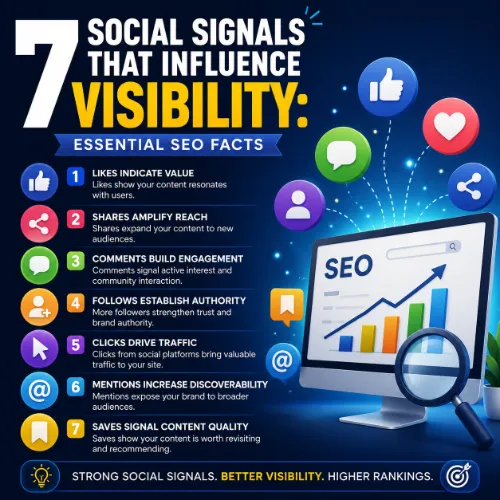
social signals that influence visibility Key Takeaways
Social engagement metrics—likes, shares, comments, and more—are not direct ranking factors, but they correlate strongly with better search visibility.
- Social signals that influence visibility include shares, comments, likes, and brand mentions, which amplify content reach and build authority.
- Active social profiles improve brand trust signals that search engines interpret as relevance cues.
- Focusing on high-quality engagement over vanity metrics gives the strongest indirect SEO boost.
Why Social Signals That Influence Visibility Matter for SEO
Search engines like Google have stated that social signals (likes, shares, comments) are not direct ranking factors. However, nearly every SEO professional observes a strong correlation between content that performs well socially and content that ranks higher in organic search. Why? Because social signals that influence visibility act as proxies for content quality, topical authority, and user trust. For a related guide, see Social Signals SEO: 5 Powerful Facts to Boost Rankings.
When a piece of content earns thousands of shares, it naturally attracts more backlinks, more brand searches, and longer dwell times—all of which are confirmed ranking factors. In this article, we break down seven specific signals that smart marketers monitor and optimize.
1. Shares: The Amplifier of Content Reach
Shares are the most visible social signal that influences visibility. Each share extends your content’s reach to a new network, increasing the likelihood of earning backlinks and referral traffic.
Shares also send a positive relevance signal. When people share your article on LinkedIn or Twitter, it suggests the content answers a question or solves a problem for that audience. Over time, repeated sharing builds topical authority in the eyes of both users and search engines. For a related guide, see 11 AI SEO Experiments: Smart Ways to Boost Your Rankings.
How to Increase Shares
Create shareable formats: listicles, how-to guides, and original research. Add “Click to Tweet” quotes, and include social sharing buttons in prominent positions.
2. Comments: The Engagement Depth Indicator
Comments indicate that readers are not just scanning but actively engaging with your content. High comment volume often leads to longer time on page and lower bounce rates—two metrics that indirectly boost rankings.
Moreover, comment sections that contain thoughtful discussion add fresh, user-generated text to the page, which can help the page rank for long-tail question-based queries.
Encourage comments by ending each section with an open question and replying to readers promptly to keep the conversation flowing.
3. Likes and Reactions: The Trust Accelerator
Likes and reactions (Facebook reactions, LinkedIn endorsements, Instagram saves) are low-effort signals, but they carry weight when aggregated. A post with thousands of likes signals social proof, making new visitors more likely to trust and engage with your brand.
From a search perspective, pages that receive heavy social approval often earn more direct traffic and branded searches—both of which help social signals influence visibility indirectly.
4. Brand Mentions (Tagged and Untagged)
When users mention your brand on social media—even without linking—it builds brand awareness and increases the brand’s overall digital footprint. Google uses brand mention volume as a trust signal, especially for competitive queries. For a related guide, see E-e-a-t Signals: 11 Essential E-E-A-T Signals Google Uses for Trust.
Use social listening tools to track mentions. Respond to mentions (positive and negative) to foster community and encourage further conversation.
5. Click-Through Rate from Social Posts
Social click-through rate (CTR) measures how often people click the link in your social post to visit your site. A high CTR tells both the social algorithm and search engines that your content is compelling.
Optimize social posts with clear value propositions: use actionable headlines, relevant images, and curiosity gaps. Test posting times to maximize CTR on each platform.
6. Video Views and Watch Time
Video content often drives the highest engagement rates on social platforms. When users watch a video from your brand on Facebook or LinkedIn, it increases brand recall and signals that your content is valuable.
Embedding high-view-count videos on your site can increase time on page, which is a positive user experience signal. Use native video uploads on social platforms rather than sharing YouTube links to maximize organic reach.
7. Social Profile Authority
A well-established social profile with many followers, consistent posting, and high engagement builds overall brand authority. This authority can indirectly affect how search engines perceive your brand’s expertise and trustworthiness.
Maintain consistent branding (profile photo, bio, URL) across platforms. Link to your website from your social profiles to reinforce the connection between your brand and your content.
How to Leverage Social Signals That Influence Visibility
To turn these signals into real SEO gains, integrate social sharing prompts naturally into your content workflow. Write headlines that spark curiosity, create visual assets for each platform, and engage with your audience in comments and DMs.
Measure your social performance using tools like BuzzSumo or native analytics on each platform. Look for patterns: which content types earn the most shares? Which posts generate the most comments? Use these insights to refine your editorial strategy.
Remember: Social signals that influence visibility are not a shortcut to rankings, but they are a powerful accelerant when paired with solid on-page SEO and strong backlinks.
Useful Resources
For deeper reading on the relationship between social signals and SEO, check out Moz’s analysis of social signals and search rankings, which covers empirical research on the topic. Also read Ahrefs’ guide to social media SEO for practical strategies to align social and search efforts.
Frequently Asked Questions About social signals that influence visibility
Are social signals a direct Google ranking factor?
No, Google has stated that social signals are not direct ranking factors, but they correlate strongly with behaviors that do influence rankings, such as link earning and brand search volume.
Which social signal is most important for SEO?
Shares tend to have the strongest indirect impact because they lead to more backlinks, referral traffic, and visibility.
Do likes on Facebook improve search rankings?
Likes themselves do not directly improve rankings, but a high like count can increase trust and click-through rates, which positively influence user engagement signals.
How do comments help SEO?
Comments add fresh, relevant text to your page and increase time on page, both of which send positive relevance signals to search engines.
Should I focus on quantity or quality of social engagement?
Quality matters more. Meaningful comments and shares from relevant audiences drive more long-term value than thousands of low-engagement likes.
Can social media profiles rank in search results?
Yes, social media profiles often appear in SERPs for brand searches, which helps control your brand’s search real estate.
Do social signals affect local SEO?
Indirectly, yes. Active social profiles that earn local engagement can increase brand awareness and local citations, which support local search visibility.
What is the best way to measure social signal impact?
Track referral traffic from social media, brand search volume, and backlinks earned after social campaigns. Tools like Google Analytics and Ahrefs can help.
Do video views count as social signals?
Yes, video views and watch time on platforms like Facebook and LinkedIn are strong engagement signals that increase content visibility on those platforms and often lead to more site visits.
How often should I post on social media for SEO benefit?
Consistency matters more than volume. Posting 3–5 times per week with high-quality content yields better results than daily low-value posts.
Do social shares help with link building?
Yes. Content that gets widely shared is much more likely to be seen by bloggers, journalists, and site owners who may link to it organically.
Can negative social mentions harm SEO?
Negative mentions can damage brand trust and increase bounce rates, which may indirectly harm rankings. Responding professionally can mitigate damage.
Do I need a large following to get SEO benefits from social signals?
No. A small, engaged following that shares and comments regularly can create more concentrated social proof than a large, passive audience.
What role does LinkedIn play in social signals for B2B SEO?
LinkedIn shares and comments are particularly valuable for B2B content because they reach industry professionals who are likely to link or cite the material.
Do social signals affect Core Web Vitals?
No direct relationship, but high social traffic can stress server resources. Ensure your hosting can handle spikes to maintain good Core Web Vitals scores.
Is Pinterest a good platform for social signals?
Yes, especially for visual content. Pinterest Pins remain discoverable for months and can drive sustained referral traffic and indirect link equity.
Should I buy social signals like likes or followers?
No. Bought signals come from bots or low-quality accounts and do not lead to genuine engagement, backlinks, or brand searches. They may even trigger platform penalties.
How do social signals compare to backlinks for SEO?
Backlinks remain a stronger, confirmed ranking factor. Social signals are complementary—they amplify the conditions that lead to earning backlinks.
Do social signals from private groups count?
Yes, but the impact is harder to measure. Engagement in niche private groups can still lead to shares and links if the content is valuable enough.
How long does it take to see SEO results from social signals?
Typically 2–6 months, depending on content quality, audience relevance, and how consistently you build social engagement alongside other SEO efforts.