
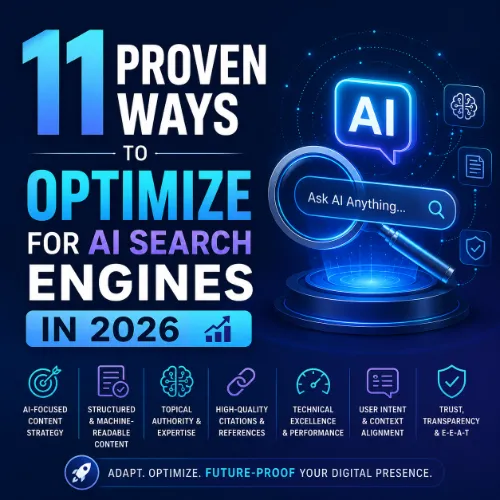
optimize for AI search engines Key Takeaways
AI-powered search engines like Google’s Search Generative Experience (SGE) and Bing Chat are reshaping how users find information.
- AI models prioritize clear, concise, and well-structured answers over keyword-stuffed pages.
- Trust signals like expert authorship, citations, and backlinks are more important than ever.
- Technical foundations — Core Web Vitals, schema markup, and indexability — directly influence AI-generated snippets.
Why You Should Optimize for AI Search Engines Now
Traditional search engines rank pages based on keywords and links. AI search engines go further: they interpret intent, extract entities, and generate natural-language summaries. If your content is not structured for extraction, AI models will pass over it in favor of more digestible sources. The time to adapt is now, while AI features are still evolving and reward early adopters with prominent placement in AI Overviews and chatbot answers.
1. Structure Content for Direct Answers
AI search engines love clear, scannable answers. Use H2 and H3 headings that match real user questions. Open with a concise summary paragraph or bulleted list that directly addresses the query. Avoid burying the core answer in fluff. For example, if your page targets “how to clean cast iron,” lead with a short step-by-step answer before diving into detailed explanation.
2. Implement Structured Data (Schema Markup)
Schema markup tells AI what your content means. Use AI search engine optimization staples like FAQ schema, HowTo schema, and Article schema. This does not guarantee a featured snippet, but it significantly increases the chance that AI will extract and display your content in answer boxes, voice responses, and knowledge panels.
3. Write in Natural, Conversational Language
AI models train on real conversations. Avoid robotic, keyword-stuffed sentences. Use natural phrasings, contractions, and transition phrases. This does not mean sacrificing professionalism — it means writing the way a smart colleague would explain something. The natural flow helps AI parse meaning and produce coherent excerpts.
4. Build Topical Authority with Entity Clusters
AI search engines favor sites that demonstrate deep knowledge on a topic. Instead of writing one thin page per keyword, create a cluster of interlinked content around a core topic. Mention related entities (e.g., tools, concepts, metrics) naturally throughout your pages. This signals to AI that you are a trustworthy source for the entire subject area. For a related guide, see 11 Essential AI Tools for Technical SEO: Smart Solutions for 2026.
5. Prioritize First-Party Data and Author Expertise
Google’s E-E-A-T guidelines directly influence AI-powered features. Include author bios with credentials, cite original research, and link to reputable external sources. If you run a health or finance site, apply YMYL (Your Money or Your Life) standards. AI models learn that pages with clear authorship and citations are more reliable.
6. Optimize for Voice and Featured Snippet Formats
Many AI search results end up in voice responses and featured snippets. To improve AI search visibility, format content for quick extraction: use tables for comparisons, numbered lists for steps, and bold the direct answer in the first paragraph. Keep paragraphs short (2-4 sentences) so AI can isolate the best sentence.
7. Focus on Core Web Vitals and Page Experience
AI search engines consider UX signals when deciding which content to feature. Slow load times, layout shifts, and delayed interactivity hurt your chances. Use tools like Google’s PageSpeed Insights to monitor LCP, FID, and CLS. A fast, stable page is more likely to be selected as the source for an AI-generated answer.
8. Use Internal Links to Guide AI Crawlers
Internal linking helps AI crawlers understand your site’s structure and prioritize important pages. Link from high-authority pages to newer or deeper content using descriptive anchor text. This also spreads link equity and helps AI associate related topics, which strengthens your topical authority score.
9. Answer “People Also Ask” Questions
AI search engines frequently pull answers from the People Also Ask (PAA) feature. Research PAA queries for your topic using tools like AlsoAsked or Ahrefs. Create dedicated H2 or H3 sections that directly answer these questions in 40-60 words. Mark them up with FAQ schema to increase the chance of being featured.
10. Monitor and Adapt to AI Overview Changes
AI search algorithms update frequently. Use rank-tracking tools to see when your pages lose or gain visibility in AI Overviews. Identify patterns: What format do the top AI results use? What sources do they cite? Adapt your content strategy accordingly. AI search engine optimization is not a one-time task; it requires ongoing refinement. For a related guide, see 8 Smart SEO Tasks You Can Automate With AI (Proven Guide).
11. Build High-Quality Backlinks from Trusted Domains
Backlinks remain a strong trust signal for AI models. Focus on earning links from authoritative, relevant sites through guest posts, original research, and digital PR. A backlink from a high-DR domain signals to AI that your content is credible enough to cite in generative answers.
SEO Entities and Their Functions
Understanding key SEO entities helps you optimize for AI search engines more effectively. Here are the most relevant ones and what they do:
- Website / Domain entities: Root domain, subdomain, and URL-level analysis identify whether performance belongs to the whole site or a single page.
- Keyword entities: Metrics like search volume, keyword difficulty, and traffic potential show demand and competition for specific queries.
- Backlink entities: Referring domains, anchor text, and dofollow/nofollow signals reveal authority and link quality.
- SERP entities: Featured snippets, AI Overviews, and People Also Ask boxes indicate the content format AI search engines reward.
- Technical SEO entities: Core Web Vitals, indexability status, and crawl issues expose obstacles that prevent AI from accessing your content.
Useful Resources
For deeper dives into AI search optimization, explore these trusted guides:
- Google Search Gallery of Structured Data — official documentation on schema types that help AI understand content.
- Ahrefs: AI Search and SEO — practical advice on how AI is changing search and what to do about it.
Optimizing for AI search engines is not a one-time tactic — it is an ongoing commitment to clarity, authority, and technical health. Start with the 11 strategies above, monitor your results, and refine as AI continues to evolve. Optimize for AI search engines today to secure your visibility tomorrow. For a related guide, see 15 Proven Link Building Strategies Still Working in 2026.
Frequently Asked Questions About optimize for AI search engines
What does it mean to optimize for AI search engines ?
Optimizing for AI search engines means tailoring your content so that AI models can easily understand, extract, and present it in generative answers, featured snippets, and voice responses.
Is traditional SEO dead because of AI search?
No, traditional SEO is not dead, but it has evolved. Core principles like keywords, backlinks, and technical health remain important, but AI adds new layers like entity understanding and answer extraction.
Do AI search engines use the same ranking factors as Google?
AI search engines rely heavily on natural language understanding, entity recognition, and trust signals, which overlap with Google’s E-E-A-T guidelines but emphasize extractability and conversational alignment.
How does structured data help AI search engines?
Structured data tells AI models exactly what type of content you have (e.g., FAQ, HowTo, recipe), making it easier for them to pull the right information for generative answers.
What is an AI overview in search results?
An AI Overview is a search engine generated summary that appears at the top of results, synthesized from multiple sources. Optimizing for extractability helps your content get included.
Should I still write long-form content for AI search?
Yes, but structure it with clear headings, short paragraphs, and concise answer sections so AI can quickly identify the most relevant parts.
How does voice search relate to AI search optimization?
Voice search queries are often conversational and longer. Optimizing for natural language directly improves your content’s suitability for both voice assistants and AI-generated answers.
Are backlinks still important for AI search rankings?
Yes, backlinks remain a strong trust signal. AI models learn that pages with links from authoritative domains are more reliable and worthy of citation.
What tools can I use to track AI search performance?
Tools like Semrush, Ahrefs, and Google Search Console help monitor visibility in AI Overviews, featured snippets, and other AI-driven features.
Does speed affect AI search visibility?
Yes, page load speed and Core Web Vitals are ranking factors that influence whether AI selects your content for a featured snippet or overview.
How often should I update content for AI search?
Update content every 6-12 months or whenever new information becomes available. Freshness signals help AI trust your page as current and relevant.
What is the role of entity coverage in AI search?
Entity coverage helps AI understand the semantic relationships between concepts, people, and things on your page, which improves topical authority and answer accuracy.
Can AI search engines index JavaScript-heavy sites?
AI crawlers can render JavaScript, but they may not wait for slow-loading scripts. Server-side rendering or static HTML is safer for critical content.
How do I optimize images for AI search?
Use descriptive alt text, compress images for speed, and include schema markup for images to help AI understand visual content and use it in answers.
Is there a penalty for using AI-generated content?
Google penalizes low-quality, unhelpful AI content regardless of how it was produced. Focus on value, originality, and accuracy, not the method of creation.
What is the difference between SGE and traditional search?
Search Generative Experience (SGE) provides AI-curated summaries instead of just a list of blue links. It selects sources based on trust, relevance, and extractability.
Should I use bullet points more for AI search optimization?
Yes. Bullet points and numbered lists are easy for AI to parse and often appear in featured snippets and AI overviews.
How do I find what questions AI search engines are answering?
Search for your target topic and note the “People Also Ask” boxes, AI Overview summaries, and featured snippet content. Those are the formats you need to match.
Can AI search engines differentiate between good and bad content?
AI models are trained on quality signals. Pages with thin content, keyword stuffing, or misleading information are less likely to be selected for generative answers.
What is the most important action for AI search optimization?
Start by structuring your top content for direct answers: clear headings, concise summaries, and schema markup. Everything else builds on that foundation.