
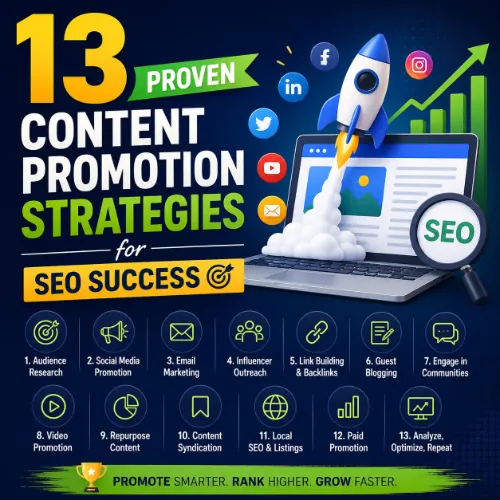
content promotion strategies for SEO Key Takeaways
Search engines evaluate authority and relevance through signals like backlinks, engagement, and freshness.
- Content promotion strategies for SEO amplify reach, attract backlinks, and signal relevance to search engines.
- Effective promotion requires a mix of outreach, syndication, social sharing, and on-site optimization.
- Consistent promotion after publication — not just on day one — compounds your organic visibility over time.
Why Content Promotion Strategies for SEO Matter in 2025
Search engines evaluate authority and relevance through signals like backlinks, engagement, and freshness. Without promotion, your best content remains invisible. A deliberate SEO content promotion plan ensures your work gets seen by the right audiences — editors, influencers, and potential linkers — so your pages earn the trust signals that drive rankings. For a related guide, see 15 Proven Link Building Strategies Still Working in 2026.
The following 13 tactics are ordered from quick wins to deeper strategic plays. Each includes an explanation, an implementation step, and a realistic expected outcome.
1. Email Outreach to Relevant Bloggers
Personalized emails to editors, journalists, and bloggers who cover your topic are still one of the most effective content promotion strategies for SEO. Instead of blasting generic templates, find writers who have linked to similar content and show them why your piece adds unique value. For a related guide, see 13 Proven Content Promotion Strategies to Boost SEO Rankings.
How to implement: Use tools like Ahrefs Content Explorer to find articles on your topic. Identify the top 10 sites that linked to those articles. Craft a short, polite email that highlights one or two fresh insights from your content. Avoid asking for a link — ask for feedback or a share.
Expected outcome: A 10–15% reply rate and 2–5 new backlinks per campaign if your content is genuinely helpful.
2. Repurpose Content for Different Formats
One blog post can become a video, an infographic, a podcast script, or a LinkedIn carousel. Each format reaches a different audience segment and increases your content’s shelf life. This is one of the most scalable promote content for SEO moves you can make.
How to implement: Take your core post and extract the top 5 tips. Turn them into a short video (2–3 minutes). Use a tool like Canva to create a simple infographic. Post the video to YouTube and embed it back in your original article — this adds a rich media signal that Google rewards.
Expected outcome: 20–40% more traffic to your post within the first month, plus potential backlinks from sites that embed your infographic or video.
3. Build Topic Clusters and Interlink
Search engines favor sites that demonstrate topical authority. By linking a new post to a cluster of related articles on your site, you create a content hub that signals expertise. This internal linking strategy is a core part of SEO content promotion that works without external outreach. For a related guide, see 11 AI SEO Experiments: Smart Ways to Boost Your Rankings.
How to implement: Before publishing, identify 3–5 existing posts on your site that relate to the new article. Add contextual links within the body of the new post to those older posts. Then go back to the older posts and add a link to the new one.
Expected outcome: A 10–20% boost in page views for all linked pages within 2–3 weeks, and a stronger overall domain authority for your site.
4. Pitch Your Content to Roundups and Resource Pages
Many blogs publish weekly or monthly roundups of the best articles in a niche. Being featured in a roundup provides an immediate backlink and social exposure. Resource pages — such as “10 Best Guides to Content Marketing” — also provide high-quality, permanent links.
How to implement: Search for “best of [your topic]” or “[topic] resources” in Google. Visit those pages and confirm they link to external articles. Find a contact email or a submission form, and send a concise pitch explaining why your article belongs in their list.
Expected outcome: 1–3 roundup backlinks per pitch round, often from moderately authoritative domains with relevant audiences.
5. Leverage Social Media Communities
Reddit, specialized Facebook groups, LinkedIn groups, and Twitter/X communities allow you to share your content with an engaged audience. The key is to add value first — answer questions, provide context, and then share your article as a natural extension of the conversation.
How to implement: Identify 3–5 active communities where your target audience asks questions. Spend one week engaging without linking. After you can see the kind of problems they have, share your article as a resource with a short explanation of how it solves those problems.
Expected outcome: 50–200 referral visits per share if the community is large and relevant; minimal link value, but strong traffic and brand awareness.
6. Submit to Content Syndication Networks
Syndicating your content on platforms like Medium, LinkedIn Articles, or Business2Community can expose your work to millions of readers. The syndicated version should be a shorter excerpt with a clear “read the full article” link back to your original piece.
How to implement: After your post is published on your own site, wait at least 48 hours. Then post a 500-word summary on Medium or LinkedIn, ending with a link to your original. Use a rel=canonical tag if the platform supports it, to avoid duplicate content issues.
Expected outcome: 300–1,000 extra page views per syndicated post, plus potential backlinks from readers who discover you through the syndicated platform.
7. Run a Guest Post Campaign
Publishing a guest post on a reputable site in your industry is one of the most reliable content promotion strategies for SEO. It builds your brand, earns a backlink, and drives referral traffic — all while positioning you as an expert.
How to implement: Find 10 blogs in your niche that accept guest contributions. Study their guidelines and past articles. Pitch a topic that complements their existing content but offers a fresh angle. Write a high-quality piece that naturally includes a link to your related article.
Expected outcome: 3–5 guest posts accepted per month, each delivering a relevant backlink and an average of 100–500 referral visitors.
8. Use Internal Promo Banners on Your Site
Visitors already on your site are your lowest-hanging fruit. A simple banner or in-text link at the end of your most popular articles can drive dozens of views to your new post every day.
How to implement: Identify your top 5 most visited blog posts using Google Analytics. Add a paragraph at the bottom of each that says something like “If you found this useful, you’ll also enjoy our guide on [new topic].” Use a tracking parameter like utm_source=internal to measure clicks.
Expected outcome: 5–15 daily clicks from each banner, totaling 150–450 monthly visits from your own audience alone.
9. Harness the Power of HARO (Help a Reporter Out)
HARO connects journalists with expert sources. By responding to relevant queries and mentioning your content, you can earn links from major news sites — some of which carry huge authority.
How to implement: Sign up for HARO and choose your industry categories. Each weekday, review the 3 daily email batches. As soon as you see a query that matches your content, respond within 30 minutes with a concise, quote-worthy answer. Include a link to your relevant article as a supporting resource.
Expected outcome: 1–3 backlinks per month from .edu, .gov, or well-known media sites if you respond quickly and provide genuine insight.
10. Engage in Broken Link Building
Broken link building is a classic outreach tactic. You find a resource page that links to a broken page, create a similar (or better) resource on your site, and ask the webmaster to replace the broken link with yours.
How to implement: Using a tool like Ahrefs Site Audit, find broken pages in your niche. Paste the URL of the broken page into the Content Explorer to see which sites link to it. Visit those linking pages, confirm the link is indeed broken, and send a polite email with your working resource.
Expected outcome: 10–20% conversion rate on outreach, with each backlink being highly relevant and often from authoritative domains.
11. Use Paid Social and Native Ads to Jumpstart Visibility
Organic promotion can take time. A small paid boost on LinkedIn, Facebook, or Taboola can get your content in front of thousands of targeted users in days. This is especially useful when your content is time-sensitive or when you need initial signals to trigger organic ranking.
How to implement: Set a modest budget ($50–$200 per campaign). Target by job title, industry, or interest depending on the platform. Create two variations of your ad — one with a question and one with a stat. After 72 hours, pause the underperforming version.
Expected outcome: 500–2,000 targeted visits per $100 spent, plus possible shares and engagement that amplify organic reach.
12. Create a Visual Asset and Submit to Creative Commons Sites
Infographics, charts, and diagrams are highly shareable. When you submit a visual to a platform like Flickr (Creative Commons) or visual content marketplaces, other publishers can embed it with attribution — earning you backlinks.
How to implement: From your article, extract a key data point or process. Use Canva or a similar tool to build a simple infographic. Upload it to a CC-friendly site with a clear attribution requirement. Include a short embed code with a link back to your article.
Expected outcome: 5–15 backlinks over the next 6 months from blogs and educational sites that use your visual, plus additional social shares.
13. Measure, Iterate, and Re-Promote
Most content promotion stops after the first week. The best practice is to re-promote your best content every few months. Monitor which channels drive the most traffic and backlinks, then double down on those.
How to implement: Use Google Search Console to see which pages are climbing in rankings. For those pages, repeat your best two promotion channels (e.g., email outreach and social sharing). Update the article with new data or examples each time you re-promote.
Expected outcome: 30–50% additional traffic from re-promotion, and a gradual but steady increase in ranking for target keywords.
Summary Table: Key Tactics at a Glance
| Tactic | Time Investment | Primary Outcome |
|---|---|---|
| Email outreach | Medium (2–3 hours per batch) | High-quality backlinks |
| Content repurposing | Medium (1–2 hours per format) | Broader audience reach |
| Topic clusters | Low (30 minutes per post) | Internal SEO signals |
| Resource page pitching | Medium (1–2 hours per list) | Relevant backlinks |
| Social communities | Low (15 minutes per day) | Referral traffic |
| Content syndication | Low (30 minutes per post) | Brand exposure |
| Guest posting | High (3–5 hours per post) | Authority and backlinks |
| Internal banners | Low (20 minutes per banner) | Click-through rate |
| HARO outreach | Medium (30 minutes per day) | High-authority links |
| Broken link building | Medium (2–3 hours per round) | De-risked backlinks |
| Paid ads | Low (1 hour per campaign) | Initial traffic surge |
| Visual asset distribution | Medium (1 hour per asset) | Linkable assets |
| Re-promotion and measurement | Low (1 hour per month) | Sustained growth |
SEO Entities and Their Functions
When executing content promotion strategies for SEO, certain entities can guide your analysis and decision-making.
- Backlink entities: Referring domains, anchor text, dofollow/nofollow status, and broken backlinks help you understand which sites link to your content and whether those links pass authority.
- Competitor entities: Competing domains, content gap opportunities, and shared keywords show where rivals earn traffic and where you can step in with better content.
- Metrics entities: Domain Rating (DR), URL Rating (UR), and referring domains count summarize the authority of your site and target pages, making it easier to prioritize promotion targets.
- Page entities: Top pages by links and traffic reveal which of your own posts are already performing, so you can focus promotion efforts on the most promising ones.
Useful Resources
For deeper guidance on backlink analysis and outreach, visit Ahrefs’ complete guide to backlink building. To understand how repurposing content boosts discovery, check out Content Marketing Institute’s repurposing guide.
Frequently Asked Questions About content promotion strategies for SEO
What is content promotion for SEO?
Content promotion for SEO means actively distributing your blog posts, guides, or videos to increase visibility, earn backlinks, and drive referral traffic — all of which can improve search rankings.
Why do I need a promotion strategy if my content is good?
Even the best content won’t rank without signals. Promotion generates those signals — backlinks, social shares, and engagement — that tell search engines your content is valuable.
How many promotion channels should I use at once?
Start with 2–3 channels that match your audience. For example, email outreach and syndication for a B2B audience; social communities and visual assets for a B2C audience.
Is email outreach still effective for content promotion?
Yes, it is one of the highest-ROI methods. Personalized emails to editors and bloggers can earn you high-authority backlinks that paid methods can’t replicate.
What is the best step-by-step plan for promoting a new post?
1) Internal links from existing posts. 2) Email outreach to 10 bloggers. 3) Share in 2 social communities. 4) Syndicate to Medium. 5) Create a visual asset and distribute it.
Can I use paid ads to promote SEO content?
Yes. Paid ads provide immediate traffic and social proof, which can trigger organic visibility. Use them as a jumpstart, not a long-term strategy.
How do I measure the success of my promotion efforts?
Track referral traffic, backlinks gained, keyword rankings for the promoted page, and social shares. Google Search Console and Ahrefs are essential tools.
What is broken link building and how does it help promotion?
Broken link building involves finding dead links on other sites, then suggesting your content as a replacement. It earns you a relevant backlink while helping the site owner fix a broken resource.
Should I guest post on the same sites I target for backlinks?
Not necessarily. Guest posting on new sites expands your reach. But if a site already links to you, a guest post there can deepen your relationship and earn additional links.
How often should I re-promote old content?
Every 2–3 months for your best-performing pages. Update the content with fresh data, then repeat your top 2 promotion channels.
What is the difference between syndication and republishing?
Syndication means sharing an excerpt with a link back to your original, while republishing copies the full article elsewhere. Syndication is safer for SEO because it avoids duplicate content issues.
Can social shares directly improve SEO?
Social shares themselves are not a direct ranking factor, but they increase visibility, drive traffic, and may lead to natural backlinks — all of which benefit SEO.
How long does it take to see results from content promotion?
Initial traffic can appear within days. Backlinks often take 2–4 weeks to build. Sustained ranking improvements typically show after 2–3 months of consistent promotion.
What is the role of topic clusters in promotion?
Topic clusters strengthen your site’s topical authority. When you promote one cluster page, the internal links benefit all related pages in the cluster, multiplying the value of your promotion effort.
Should I use automation tools for email outreach?
Use automation to organize prospects and send follow-ups, but keep the initial email personal. Automated copy-and-paste campaigns result in low success rates.
How do I find broken links in my niche?
Use Ahrefs Site Audit or a free broken link checker. If you don’t have paid tools, use Google dork searches like “site:.edu [your topic] 404.”
What is the best time of day to share content on social?
Studies suggest 9–11 AM EST on weekdays for LinkedIn and Twitter, and 2–4 PM for Facebook. Test your audience’s engagement patterns and adjust.
Is it worth promoting content if my site is new?
Absolutely. In fact, promotion is even more critical for new sites because you have no existing audience. Focus on guest posting and resource page pitching to build initial authority.
How many backlinks does a typical article need to rank?
There is no fixed number. For low-competition keywords, 3–5 high-quality backlinks may suffice. For competitive terms, you may need 20–50 from relevant domains.
What is the biggest mistake in content promotion?
Promoting only once and then never revisiting the content. The most successful promoters treat promotion as an ongoing process, not a one-time launch event.