
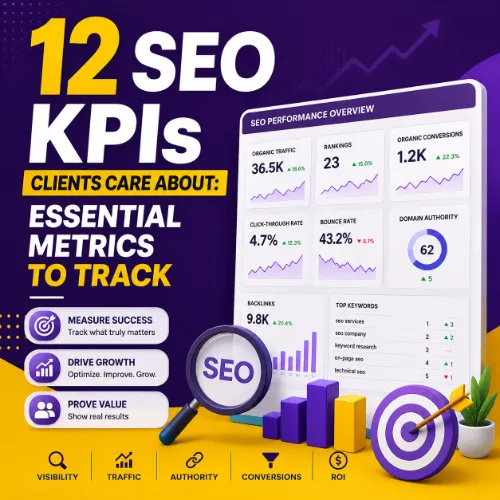
SEO KPIs clients care about Key Takeaways
Understanding the SEO KPIs clients care about is essential for any agency or in-house team that wants to prove the real impact of search engine optimization.
- The most important SEO KPIs clients care about are organic traffic, keyword rankings, conversion rate, and return on investment (ROI).
- Client-friendly reporting focuses on trends, not just snapshots, and ties each KPI to a tangible business outcome.
- By mastering these 12 metrics, you can build lasting trust, justify budgets, and align SEO strategy with client goals.
What Are the SEO KPIs clients care about?
Before diving into the list, it helps to understand why these 12 metrics matter more than others. Clients rarely care about raw data alone; they care about what the data means for their bottom line. Each KPI you track should answer a question like “Are we getting more visitors?” or “Is our traffic actually converting?” The goal is to show the direct line between SEO work and business results. For a related guide, see 9 SEO Dashboards Every Agency Needs.
12 Essential SEO KPIs clients care about for Reporting
Below are the 12 key performance indicators that every SEO professional should include in their client reports. Each KPI includes a definition, why it matters to the client, and a practical tip for accurate measurement.
1. Organic Traffic
Definition: The total number of visitors coming to the website from unpaid search results. Why clients care: It is the most direct measure of SEO visibility and reach. Tip: Segment organic traffic by landing page to show which content drives the most visits.
2. Keyword Rankings
Definition: The position of target keywords in search engine results pages (SERPs). Why clients care: Clients want to see improvements for high-value terms that bring qualified traffic. Tip: Focus on ranking movements for non-branded keywords to demonstrate real organic growth.
3. Conversion Rate
Definition: The percentage of organic visitors who complete a desired action, such as filling out a form or making a purchase. Why clients care: It proves that traffic is not just vanity—it leads to leads or sales. Tip: Set up goal tracking in Google Analytics to measure conversions from organic sessions specifically.
4. Bounce Rate
Definition: The percentage of single-page visits where the user leaves without interacting further. Why clients care: A high bounce rate can indicate poor content relevance or page experience. Tip: Compare bounce rates across different landing pages to identify which ones need optimization.
5. Pages Per Session
Definition: The average number of pages a user views during a single session. Why clients care: It signals engagement and content quality. Tip: Use internal linking strategies to increase pages per session and keep visitors exploring.
6. Average Session Duration
Definition: The average length of time a visitor spends on the site per session. Why clients care: Longer sessions often correlate with higher interest and better content. Tip: Improve session duration by adding video, interactive elements, or more detailed guides.
7. Organic Click-Through Rate (CTR)
Definition: The percentage of users who click on your listing after seeing it in the SERPs. Why clients care: A low CTR despite good rankings suggests the title tag or meta description needs improvement. Tip: Test different title tags and meta descriptions using A/B testing tools like Google Search Console.
8. Backlink Growth
Definition: The number of new referring domains pointing to the site over a given period. Why clients care: Backlinks are a strong authority signal and correlate with higher rankings. Tip: Report both new and lost backlinks each month to show net growth and potential risks.
9. Domain Authority (DA) / Domain Rating (DR)
Definition: A score that predicts how well a website will rank in search engines (often on a 1–100 scale). Why clients care: It provides a single-number summary of the site’s overall authority. Tip: Track DA/DR changes quarterly rather than weekly to avoid noise from algorithm fluctuations.
10. Return on Investment (ROI)
Definition: The revenue generated from organic traffic compared to the cost of SEO efforts. Why clients care: This is the ultimate business metric that justifies ongoing investment. Tip: Assign a monetary value to each conversion type (lead, sale, call) to calculate ROI accurately.
11. Local Pack Appearances
Definition: How often the business appears in the Google Local Pack (the map+listings block). Why clients care: For local businesses, this is often the primary source of customers. Tip: Optimize Google Business Profile listings and collect positive reviews to improve local pack visibility.
12. Page Load Speed (Core Web Vitals)
Definition: Metrics like Largest Contentful Paint (LCP), First Input Delay (FID), and Cumulative Layout Shift (CLS). Why clients care: Google uses these as ranking factors, and slow pages hurt user experience. Tip: Use tools like PageSpeed Insights or Ahrefs Site Audit to identify bottlenecks and track improvements. For a related guide, see 7 Social Signals That Influence Visibility: Essential SEO Facts.
SEO Entities and Their Functions
Understanding how the entities behind these metrics work improves your ability to explain them to clients:
- Website / Domain entities (root domain, subdomain, URL-level) help pinpoint whether performance is site-wide or limited to a specific section or page.
- Keyword entities (organic keywords, keyword difficulty, search volume) reveal demand and competition for target terms.
- Backlink entities (referring domains, anchor text, dofollow/nofollow) clarify authority sources and link quality.
- Page entities (top pages by traffic, top pages by links) show which URLs earn visibility and authority.
- Technical SEO entities (crawl issues, Core Web Vitals, indexability) expose obstacles that block search performance.
Comparison Table: The 12 SEO KPIs clients care about
| KPI | Primary Focus | Reporting Frequency |
|---|---|---|
| Organic Traffic | Visibility and Reach | Monthly |
| Keyword Rankings | SERP Positioning | Weekly |
| Conversion Rate | Business Value | Monthly |
| Bounce Rate | Engagement | Monthly |
| Pages Per Session | Content Depth | Monthly |
| Average Session Duration | User Interest | Monthly |
| Organic CTR | Listing Appeal | Monthly |
| Backlink Growth | Authority | Monthly |
| Domain Authority/DR | Overall Authority | Quarterly |
| ROI | Revenue | Quarterly |
| Local Pack Appearances | Local Visibility | Weekly |
| Core Web Vitals | User Experience | Monthly |
Useful Resources
Learn more about measuring and reporting these metrics from trusted sources:
- Ahrefs: The 16 Most Important SEO KPIs You Should Track – A comprehensive guide to key metrics with definitions and examples.
- Moz: How to Choose the Right SEO KPIs for Your Clients – Practical advice on aligning KPIs with client goals.
Frequently Asked Questions About SEO KPIs clients care about
What are the most important SEO KPIs to show clients?
The top five are organic traffic, keyword rankings, conversion rate, backlink growth, and ROI because they directly tie SEO work to business outcomes.
How often should I report SEO KPIs to clients?
Most agencies report monthly for core metrics like traffic and conversions, while keyword rankings may be shared weekly. Quarterly reviews are best for ROI and domain authority.
What is a good organic conversion rate?
It varies by industry, but ecommerce sites often see 2-3%, while B2B websites might see 5-10% for lead generation forms. Always benchmark against historical data.
How do I prove SEO ROI to my clients?
Assign monetary values to conversions (e.g., average order value or lead value) and compare that total revenue against the cost of SEO services and tools.
Is bounce rate still a useful SEO KPI?
Yes, but only when analyzed in context. A high bounce rate might be fine for a blog post if the user finds the answer quickly, but it’s a concern for landing pages or product pages.
Why do clients care about keyword rankings?
Keyword rankings are a tangible, easy-to-understand indicator of search visibility. Clients feel reassured when they see terms moving up, especially for brand or high-value queries.
Should I include Core Web Vitals in client reports?
Yes, especially for technical SEO clients. Core Web Vitals directly impact user experience and are a known ranking factor, so showing improvements can build trust.
What are local pack appearances?
They are the number of times your business appears in the Google Local Pack (the map with three business listings). It’s critical for local businesses like restaurants or dentists.
How do I track backlink growth?
Use tools like Ahrefs or Moz to monitor new referring domains and lost backlinks. Report the net change each month to show link-building effectiveness.
What is organic CTR?
Organic click-through rate is the percentage of users who see your listing in the search results and click on it. A low CTR may indicate weak title tags or meta descriptions.
How do pages per session help clients?
It shows how engaged visitors are. Higher pages per session often means users find your content valuable and are exploring more, which can lead to higher conversions.
What is the difference between DA and DR?
Domain Authority (Moz) and Domain Rating (Ahrefs) are proprietary scores that predict ranking ability. Both are useful, but always use the same tool consistently when reporting trends.
Do clients really care about average session duration?
Yes, especially when combined with bounce rate. Longer sessions suggest users are consuming more content, which is a positive signal for content quality and engagement.
How do I set up conversion tracking for SEO?
In Google Analytics, create goals (e.g., form submissions, purchases) and filter them by organic traffic source. Use UTM parameters for even more granular tracking.
What is a good organic traffic growth rate?
Aim for 10-20% month-over-month growth in the first six months for new sites. Established sites may see 5-10% monthly increases with consistent optimization.
Should I include paid traffic in my SEO report?
Only if the client has paid campaigns. Otherwise, keep reports focused on organic metrics to avoid confusion and maintain clarity about SEO’s contribution.
How do I explain a drop in rankings to clients?
Be transparent. Mention possible causes such as algorithm updates, competitor activity, or technical issues. Offer a plan for recovery, like content refreshes or link building.
What tools do you recommend for tracking SEO KPIs?
Google Search Console, Google Analytics, Ahrefs, and Moz are the industry standards. Choose based on budget and depth of insights needed.
Is it okay to focus on only 5 KPIs for small clients?
Absolutely. For smaller businesses or limited budgets, focus on organic traffic, keyword rankings, conversion rate, ROI, and Core Web Vitals. Quality over quantity.
How do I make my SEO reports more client-friendly?
Use clear visuals, avoid jargon, and always explain why a metric matters. Include a one-page executive summary that ties all KPIs back to business goals.